

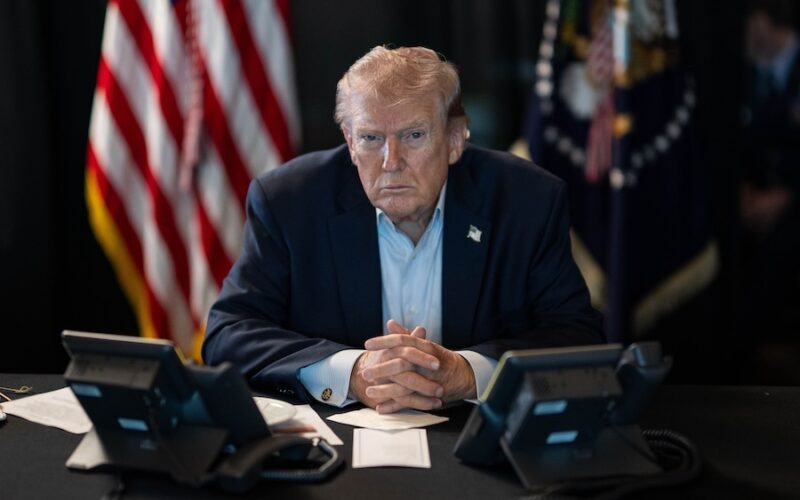
President Donald Trump expressed his discontent with two Supreme Court justices he appointed, condemning their stance in a significant tariffs case. In a candid post on Truth Social, he voiced concerns that Justices Neil Gorsuch and Amy Coney Barrett might soon deliver a ruling on birthright citizenship that could harm the country.
In a substantial 545-word message, Trump directed his criticism at his former appointees following the court’s decision to invalidate his efforts to impose tariffs using emergency powers. He stated, “I don’t want loyalty, but I do want and expect it for our Country,” showcasing his disappointment with the justices.
The Supreme Court ruled 6-3 in late February, declaring Trump’s tariffs unconstitutional. Gorsuch and Barrett sided with Chief Justice John Roberts and the court’s liberal justices, leading to frustration from Trump.
Trump estimated that the ruling could lead to $159 billion in repayments linked to tariffs already enforced. He cautioned that a negative outcome regarding birthright citizenship, following the tariffs ruling, would be economically detrimental to the nation.
The upcoming decision on birthright citizenship is expected soon, as Trump has been vocal against “birth tourism,” where foreign nationals give birth in the U.S. to secure citizenship for their offspring.
Trump emphasized his original intention in appointing these justices, saying he chose them to aid the nation, not hinder it. He reflected on being the first president to attend a Supreme Court session, remarking on the lack of acknowledgment from the court and media.
Trump further criticized the court for not including a provision that would prevent repayment of previously collected tariffs, questioning why it wasn’t addressed.
Expressing his respect for Gorsuch and Barrett, he lamented their recent votes against him, stating, “They have hurt our Country so badly!” He pointed out that the financial repercussions of their decisions are hard to believe.
Additionally, Trump speculated on the idea of expanding the Supreme Court, a notion generally associated with Democrats, arguing it might be necessary given the current court’s dynamics.
Finally, he contrasted the reliability of conservative justices to their liberal counterparts, suggesting that Democratic nominees consistently support those who appointed them.
