
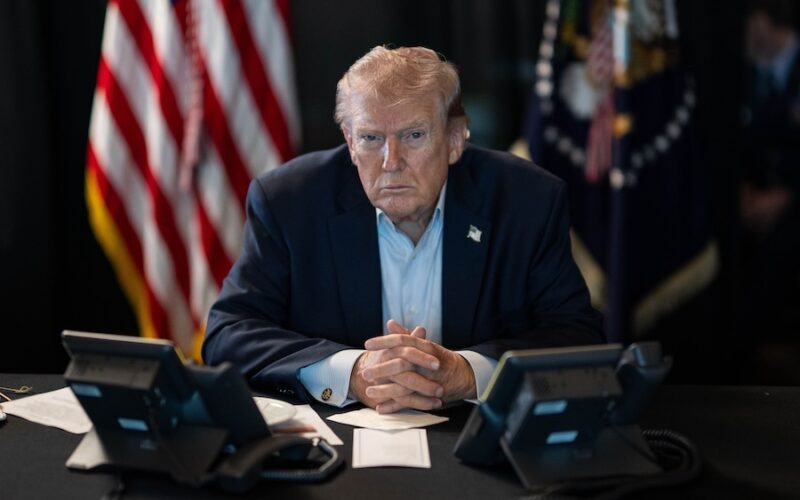
On Thursday, President Donald Trump announced an extension to a significant deadline regarding U.S. military actions against Iran, hinting at a possible diplomatic initiative even as tensions continue to rise in the area.
Trump shared on Truth Social that he would be pausing the “period of Energy Plant destruction” for an extra 10 days, adjusting the deadline to April 6, 2026, at 8 p.m. Eastern Time.
He stated, “As per Iranian Government request… I am pausing the period of Energy Plant destruction by 10 Days,” emphasizing that negotiations are proceeding well, contrary to media portrayals.
This announcement comes as conflicts involving the U.S., Israel, and Iran escalate into a broader regional war. Coordinated strikes by the U.S. and Israeli forces have targeted Iranian military sites, while Iran has retaliated through both direct attacks and proxies.
The postponement of actions against Iran’s energy sector seems aimed at fostering diplomacy. Iran’s energy infrastructure is crucial to its economy and significantly affects global oil markets.
Disruptions near the Strait of Hormuz, a vital pathway for a substantial portion of the world’s oil supply, have raised alarms about global energy prices and supply chain instability.
Trump asserts that Iran is eager for a deal, reportedly claiming they are “begging” to negotiate. Yet, he’s also warned that failing to reach an agreement could lead to heightened military responses, including possible strikes on key Iranian leaders.
A source familiar with the mediation process informed Axios that despite publicly denying U.S. proposals, Iranian officials have shown a private willingness to continue discussions.
However, they have not yet confirmed their participation in an upcoming high-level meeting with the U.S. Mediators are actively encouraging Tehran to commit, yet Iranian representatives have conveyed that senior leadership has not made a decision.
“The key issue for the mediators is to make the meeting happen. But the primary challenge remains the mistrust and the Iranian concern that the U.S. is deceiving them again,” the source stated.
The administration has refrained from officially labeling the situation as war, which would require further legal and congressional considerations. Nevertheless, U.S. forces remain engaged, and military operations continue alongside diplomatic pursuits.
The 10-day extension marks a pivotal moment in the conflict. Currently, the region sits in a precarious situation, balancing military action with the prospect of negotiations.
White House envoy Steve Witkoff mentioned during a Cabinet meeting that several nations, including Pakistan, Egypt, and Turkey, have recently approached Washington offering to assist in mediation.
“This has led to strong and positive talks … we will see where this goes and if we can persuade Iran that this is a turning point with no favorable alternatives other than further devastation. We see strong signs that this is a real possibility,” he asserted.
RELATED:REPORT: Thousands Of U.S. Marines Expected In Middle East By Friday
