

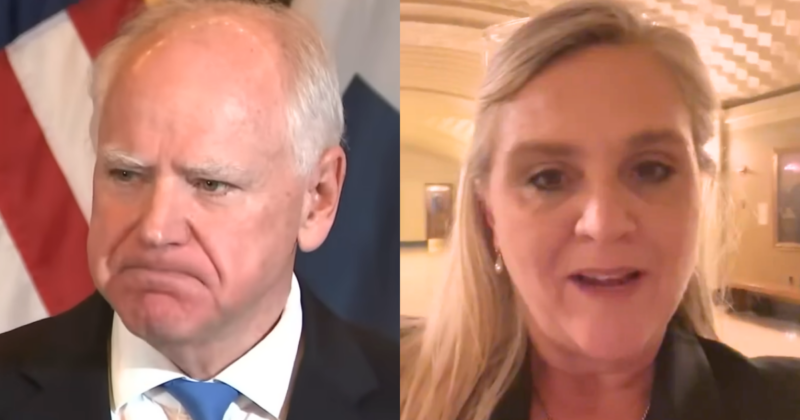
Minnesota State Rep. Pam Altendorf (R‑District 20A) sounded the alarm after reporting a display she said she encountered inside the Minnesota State Capitol—a plaque allegedly presented to Gov. Tim Walz (D) by a group calling itself the Democratic Coalition of Satan Worshippers.
Altendorf filmed her remarks on the ground floor of the Capitol, reading aloud the text she said appeared on the plaque.
“This is Representative Pam Altendorf coming alive at you from the Minnesota State Capitol,” she began. “I am on the ground floor, and as I was leaving my committee meeting today here earlier, I noticed that there is a new display here at the State Capitol, and it’s for Governor Walz.”
According to Altendorf, the plaque read, “Thanks Governor Tim Walz for not standing in the way of spreading Satanism in the state capitol building. Satan has a special place for you.”
She emphasized the group’s name, adding, “I don’t know why a governor of a state would want this plaque, but there it is. Yes, everyone, this is true. I am live not making this up. You can’t make this up.”
Social media quickly amplified the report, with many disturbed by the plaque.
“This alone tells you everything you need to know,” one X user wrote.
Another wrote, “Democrats are the party of the devil,” while another added, “It’s all making sense now.”
The post sparked widespread conversation, with many questioning the appropriateness of the display within an official government building.
Altendorf questioned the reasoning behind allowing the plaque to remain and speculated whether the governor could decline such presentations.
“I would think if you’re Governor Tim Walz, you could choose not to have up this plaque,” she said, reflecting on the unusual nature of the scene.
The incident echoes a broader pattern of controversial displays in state and federal capitols.
In 2018, members of The Satanic Temple briefly installed an 8.5-foot Baphomet statue at the Arkansas State Capitol to protest a Ten Commandments monument, citing religious freedom concerns.
In 2014, The Satanic Temple also proposed a 7-foot statue at the Oklahoma State Capitol to sit near a Ten Commandments display, drawing legislative pushback.
Last year, Iowa officials denied a request for a Satanic holiday display, prompting complaints citing religious freedom protections.
These examples illustrate how religious or politically symbolic displays in government buildings often trigger public debate and legal scrutiny.
Altendorf’s report highlights how social media now accelerates public awareness, with individual observations reaching thousands within minutes.
The plaque’s presence and the ensuing viral response underscore ongoing tension over what types of messages are permitted in official state spaces and how the public interprets political symbolism.
The incident adds to a growing national conversation about oversight of displays in government buildings, the boundaries of free expression, and the role of elected officials in responding to controversial content.
Altendorf’s on-the-ground reporting, combined with the rapid online reaction, demonstrates the intersection of local governance, political symbolism, and social media influence in shaping public debate.
WATCH:
