

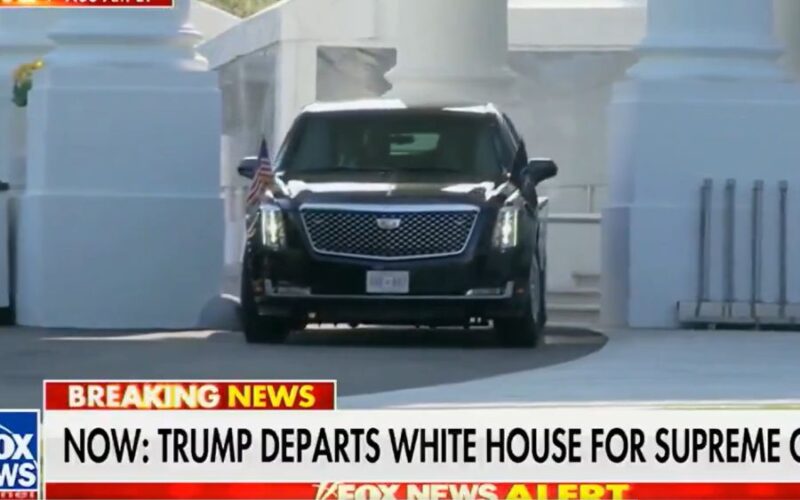
President Donald Trump will attend the Supreme Court to participate in discussions regarding his administration’s efforts to revise birthright citizenship policy. This historic event marks the first instance of a sitting president being present for oral arguments.
The court is slated to examine the legality of Trump’s executive order, which seeks to terminate automatic citizenship for many children born to parents living in the U.S. illegally or on temporary visas.
Trump’s courtroom presence is being termed historic, as it breaks new ground for presidential involvement in legal proceedings. Attorney General Pam Bondi will also be in attendance.
Central to the matter is Trump’s executive order 14160, titled “Protecting the Meaning and Value of American Citizenship.” This directive instructs federal agencies to deny citizenship documents to children of undocumented immigrants and to those born to parents on temporary visas.
The order will affect births occurring in the U.S. after February 19, 2025.
The case, Trump v. Barbara, presents a critical confrontation over the Citizenship Clause in the 14th Amendment. This clause asserts that citizenship is granted to individuals born in the United States and subject to its jurisdiction.
Trump’s legal team highlights the phrase “subject to the jurisdiction thereof,” arguing it has been misinterpreted for years and was originally meant to limit citizenship to newly freed slaves and their offspring following the Civil War.
U.S. Solicitor General D. Sauer urged the high court to consider the case, stating that prior rulings incorrectly assumed that birthplace guarantees citizenship. He argues these decisions unjustifiably grant citizenship to many who should not qualify.
Critics assert that Trump’s order is unconstitutional and disrupts established law. They caution it could alter the status of approximately 150,000 U.S.-born children of noncitizens annually, raising immediate concerns about legal documentation for hospitals and governmental agencies.
The justices will deliberate on established precedents, including the significant United States v. Wong Kim Ark ruling from 1898, which underpins birthright citizenship today, as well as the 1952 Immigration and Nationality Act that aligns with the 14th Amendment’s provisions.
Amanda Frost, a law professor at the University of Virginia, argued there are substantial reasons for the court to uphold the traditional interpretation of the citizenship clause.
John Yoo, from UC Berkeley, expressed skepticism regarding the historical validity of the Trump administration’s stance and suggested key insights might emerge from Chief Justice John Roberts and Justice Brett Kavanaugh.
The practical implications of any ruling will be a significant focus. Kavanaugh has raised concerns about how the executive order would function in real-life scenarios involving newborns.
Justice Sonia Sotomayor countered this position strongly, indicating that it raises serious conflicts with established precedents and poses risks of statelessness for children.
The ultimate decision will represent a major test of Trump’s immigration policies and challenge the long-held understanding of American citizenship.
