

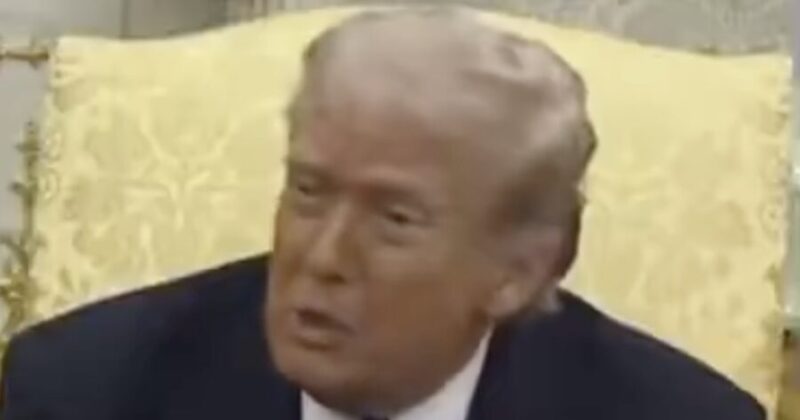
President Donald Trump offered his clearest explanation yet of what he sees as the true “worst case” in the U.S.-Israel conflict with Iran.
He made the comments during a bilateral meeting with German Chancellor Friedrich Merz at the White House while reporters pressed him on contingency planning.
A reporter asked, “What’s the worst case scenario that you have planned for in Iran?”
“Well, I don’t know if there’s a worst case,” Trump responded.
He said U.S. and Israeli forces are systematically degrading Iran’s missile capabilities.
“We’re hitting all of their missile stock,” Trump said.
He emphasized that his primary worry is the political aftermath rather than battlefield losses alone.
He said the bigger danger would be replacing the regime with someone “as bad as the previous person,” leaving ordinary Iranians no better off.
He urged civilians to avoid protests while bombardment continues, saying, “If you’re going to go out and protest, don’t do it yet.”
“It’s very dangerous out there,” he warned.
WATCH:
Reporter: What’s the worst-case scenario that you have planned for in Iran?
Trump: Worst case is replacing Iranian leaders with someone… no better! pic.twitter.com/ZcSxhL9emk
— Viory Video (@vioryvideo) March 3, 2026
Military Campaign
The United States and Israel have carried out heavy airstrikes across Iran.
Military and government targets in Tehran have been hit, including reported strikes near the presidential office and national security council facilities.
According to U.S. officials, hundreds of strikes have already occurred as part of a coordinated campaign.
Officials have described the bombing as heavy and uninterrupted.
Reports indicate roughly 800 people have died so far, including Iranian civilians and combatants across multiple fronts.
The U.S. military has confirmed that six American service members have been killed during the conflict.
Missile and drone exchanges have wounded and killed others throughout the region.
Iran and Iranian-backed militias have retaliated with missile and drone strikes targeting Israel and U.S. bases and facilities in Gulf states.
Attacks have impacted infrastructure in Kuwait and Saudi Arabia and have affected diplomatic compounds, including U.S. embassy sites.
The fighting has also spread to Lebanon, where Israel has launched additional strikes in response to militia activity.
Trump has defended the operation as necessary to neutralize Iran’s military capabilities and prevent future threats.
For now, he appears less concerned about missile counts than about what follows them.
In his view, the true “worst case” is a post-conflict Iran that looks much the same as before.
