

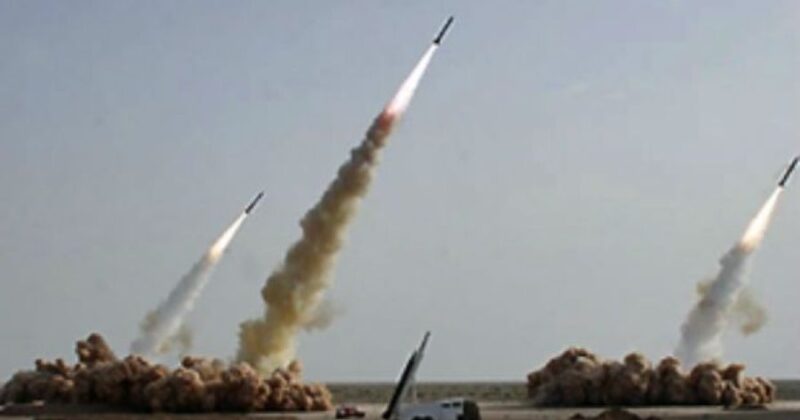
President Donald Trump is warning that Iran is developing missile capabilities that could soon put the United States within range.
U.S. officials say Iran currently lacks an intercontinental ballistic missile able to strike the American homeland.
Still, Washington is alarmed as Tehran’s missile arsenal has become a major flashpoint in nuclear negotiations and a growing danger to U.S. forces across the Gulf.
Experts widely regard Iran as fielding the region’s largest ballistic missile force.
Its stockpile is dominated by short- and medium-range ballistic missiles with ranges up to about 2,000 kilometers, roughly 1,200 miles.
That reach covers a long list of U.S. military sites in the Middle East that would sit inside Tehran’s crosshairs.
Among the installations within reach are Al Udeid Air Base in Qatar, the forward headquarters for U.S. Central Command; Naval Support Activity Bahrain, home to the 5th Fleet; Camp Arifjan and Ali Al Salem Air Base in Kuwait; Prince Sultan Air Base in Saudi Arabia; Al Dhafra Air Base in the United Arab Emirates; and Muwaffaq Salti Air Base in Jordan.
Real Attacks and U.S. Response
The threat is concrete, not theoretical.
In January 2020 Iran launched more than a dozen ballistic missiles at U.S. positions in Iraq after the U.S. strike that killed Iranian Gen. Qassem Soleimani.
Dozens of American service members later reported traumatic brain injuries, underscoring the exposure of forward-deployed personnel.
As tensions have risen, the United States has increased its military posture in the region with carrier strike groups, destroyers and Air Force fighters.
Those forces aim to provide added muscle while diplomacy with Tehran remains uncertain.
Risks Beyond the Middle East
Iran’s missile capability could also threaten parts of southeastern Europe depending on launch locations.
Countries such as Greece, Bulgaria and Romania could fall within range, although strikes deeper into Europe would require longer-range systems than Iran has shown operationally.
Reaching the U.S. East Coast would demand a missile with a range of roughly 10,000 kilometers, far beyond Iran’s known capabilities for now.
U.S. intelligence agencies have warned that Iran’s space launch program could provide technological building blocks for a future ICBM if Tehran decides to pursue that path.
The Defense Intelligence Agency recently assessed that Iran ‘has space launch vehicles it could use to develop a militarily-viable ICBM by 2035 should Tehran decide to pursue the capability.’
Policy Implications
The immediate danger, administration officials say, is to the tens of thousands of American troops already inside Iran’s missile envelope.
That, they argue, is why limits on ballistic missiles cannot be treated as a sidebar in nuclear talks.
Secretary of State Marco Rubio has called Iran’s refusal to discuss limits on its ballistic missile program ‘a big problem,’ and delivery systems are inseparable from the broader nuclear threat.
President Trump’s warning aims to keep attention on the threat and justify firm defense and diplomatic measures.
