

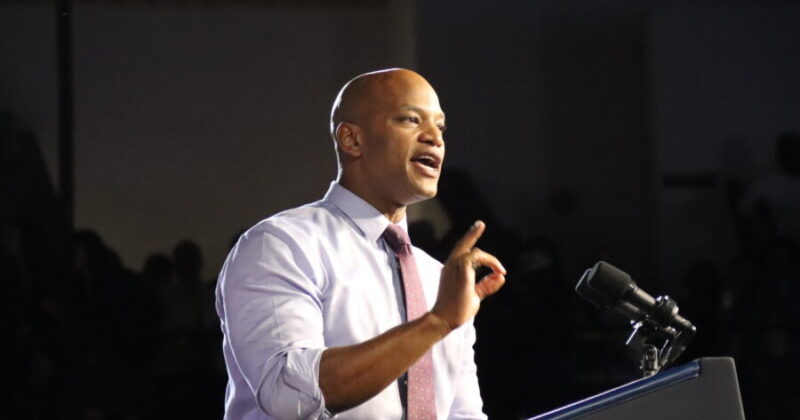
The dramatic family story Maryland Gov. Wes Moore often tells on the campaign trail has helped power his rise as a national Democratic figure. But according to reporting by Andrew Kerr of the Washington Free Beacon, the tale does not hold up against historical records.
Moore, widely viewed as a potential 2028 Democratic presidential candidate, frequently recounts how his grandfather fled South Carolina as a child in the 1920s after the Ku Klux Klan targeted the family. Moore says his great-grandfather, a Black minister, enraged the Klan with sermons condemning racism, forcing the family to escape Charleston in the dead of night to avoid a lynching before resettling in Jamaica.
It is a gripping narrative Moore has repeated for years, including during his successful 2022 run for governor. He first told the story in a 2014 memoir and has since framed it as a defining example of American injustice and perseverance.
But as Andrew Kerr reported for the Free Beacon, the historical record contradicts Moore’s account on nearly every major point.
Moore’s great-grandfather on his mother’s side, the Rev. Josiah Johnson Thomas, did preach in South Carolina during the early 1920s. Church archives indicate that Thomas served at the Episcopal Church of the Redeemer in Pineville, S.C., approximately 65 miles north of Charleston. Those same records, however, show no evidence that Thomas fled the country in secret, was targeted by the Ku Klux Klan or preached publicly against racism in a way that drew Klan retaliation.
According to Episcopal Church records and contemporaneous newspaper coverage cited by the Free Beacon, Thomas made a formal and public transfer from South Carolina to Jamaica on Dec. 13, 1924. He returned to the island of his birth to succeed a prominent Jamaican pastor who had died unexpectedly a week earlier.
There is no documentation indicating that Thomas was chased out of the United States or that his departure was sudden or covert. While the Ku Klux Klan operated openly in South Carolina during the 1920s, it never maintained a chapter in Pineville, according to Virginia Commonwealth University’s Mapping of the Second Ku Klux Klan project.
Moore has expanded the story over time. During a 2020 appearance on Andrew Yang’s podcast, Moore said the Klan ran his grandfather and “the rest of my family out of this country, not just out of Charleston, South Carolina.” Time magazine later reported in 2023 that Moore’s great-grandfather was “targeted for lynching.”
Moore repeated that version in a commencement speech last May at Lincoln University in Pennsylvania, saying his grandfather was “chased away by the Ku Klux Klan” because “my great-grandfather was a vocal minister in the community.”
“Being Black and outspoken was a crime—even if it wasn’t on the books,” Moore said. “So, in the middle of the night, they fled. My grandfather may have been just a boy… but he never forgot what happened that night.”
Church records reviewed by the Washington Free Beacon tell a different story. They show Thomas was officially “transferred” to Jamaica through a formal Episcopal Church process that required approval from multiple church authorities. The move followed standard procedure and shows no sign of urgency or fear.
“Typically, when a clergy member moves from one diocese to another, it is at the request of the clergy member, who works in concert with the new parish,” Amy Evenson, an archivist at the national Episcopal Archives in Austin, Texas, told the Free Beacon. “All parties must agree that the move is advantageous, which is then approved by the Bishop.”
Reporting from Jamaica’s Daily Gleaner further undermines Moore’s account. The paper reported that Thomas returned to Jamaica to take over for the Rev. George Lewis Young, a highly respected pastor whose funeral drew thousands and senior colonial officials.
When Thomas spoke to the Daily Gleaner about his return, he made no mention of threats, racial violence or the Ku Klux Klan. The paper reported that he “laboured in the States for a number of years, and like many other Jamaicans he has returned to his native land to work among his people.”
Thomas quickly resumed public life in Jamaica. The island’s governor appointed him as a marriage officer shortly after his return, the paper reported.
The Free Beacon also found no evidence supporting Moore’s claim that the Klan targeted Thomas over his sermons. In 1924, then-South Carolina bishop William Guerry reported that the Pineville church where Thomas preached was well regarded by the surrounding white community.
Guerry, who personally oversaw Thomas’s ordination in 1923, wrote that the church had earned trust through its community work and medical services. After Thomas left for Jamaica, Guerry reported in 1925 that the church’s “colored work” was “in a most prosperous condition,” with no reference to Klan intimidation or violence.
The discrepancy adds to a pattern of inflated or false biographical claims by Moore that have previously drawn scrutiny. As the Washington Free Beacon has reported, Moore has falsely claimed he was born and raised in Baltimore, said he was inducted into a Maryland College Football Hall of Fame that does not exist, and stated he received a Bronze Star he did not earn. He has also claimed academic credentials at Oxford University that he has been unable to document.
Moore’s family story dates back a century, but the records surrounding his great-grandfather’s life are extensive and detailed. Taken together, they depict a routine church transfer and a respected clergyman returning home — not a family fleeing the Ku Klux Klan under cover of darkness.
