
Ohio, while no longer the quintessential swing state, is providing insight into the upcoming political battles as we approach 2026.
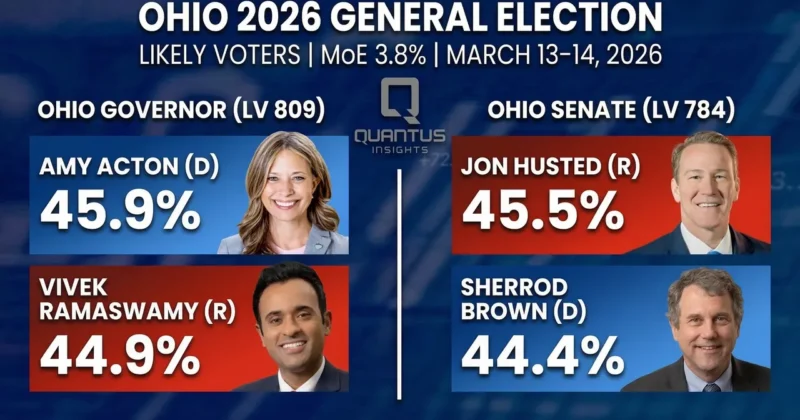
A recent Quantus Insights poll conducted on March 13-14 reveals a divided Ohio electorate, exhibiting concerns about the economy and showing ambivalence toward both major parties.
The race for governor is particularly tight, with Democrat Amy Acton garnering 45.9% support, closely followed by Republican Vivek Ramaswamy at 44.9%. An undecided 5.9% and 3.3% supporting other candidates highlight the competitive nature of the contest.
This narrowing margin comes after earlier polling indicated a more substantial lead for Acton, suggesting a shift as the campaign gains momentum.
Neither candidate has yet reached 50%, indicating that many voters are still deliberating their choices ahead of the election.
The Senate race mirrors this closeness with Republican incumbent Jon Husted leading at 45.5%, while Democrat Sherrod Brown trails closely behind at 44.4%. With 6.5% undecided and 3.6% favoring other candidates, the outcome remains uncertain.
While Brown has long positioned himself as a pro-labor advocate in Ohio’s traditional industrial regions, the tight numbers suggest his message may be facing challenges in a state that has shifted rightward in recent years.
Husted, who stepped into the role following JD Vance’s departure to serve as vice president, is still establishing his presence.
Trump’s influence in Ohio is significant, with 47% of voters approving of his job performance, juxtaposed against 50% disapproving. About 44% of voters indicate their opinions on Trump have remained the same.
The economy tops the list of concerns, with 25% of voters prioritizing inflation and living costs. Issues like democracy, border security, healthcare, taxes, crime, foreign policy, and election integrity also resonate.
When it comes to economic trust as governor, Ramaswamy holds an edge with 42.9%, over Acton’s 36.2%. This advantage is critical in a state where economic issues dominate discussions.
In the Senate context, however, Brown outperforms Husted on economic trust with 44.2% compared to 39.6%. This suggests that Brown’s ongoing advocacy for manufacturing jobs is still connecting with a segment of the populace.
Immigration stands out as another vital subject, with 44% of voters supporting current deportation policies. Ramaswamy leads Acton in handling immigration at 41% versus 37%, though a portion remains undecided.
Healthcare presents a different picture; Acton leads with 42.6% against Ramaswamy’s 39.0%, marking one of the few issues where Democrats hold a clear lead.
Similarly, Brown claims a slight edge in being perceived as a representative for working families, with 44% favoring him over Husted’s 40%.
Overall, this survey underscores Ohio’s continuing political competitiveness, reflecting Republican advantages in immigration and economic messaging, while Democrats maintain support in healthcare and working-class narratives. As inflation and spending continue to concern Ohioans, the party that successfully presents a fiscal strategy will likely gain the upper hand in 2026.
