

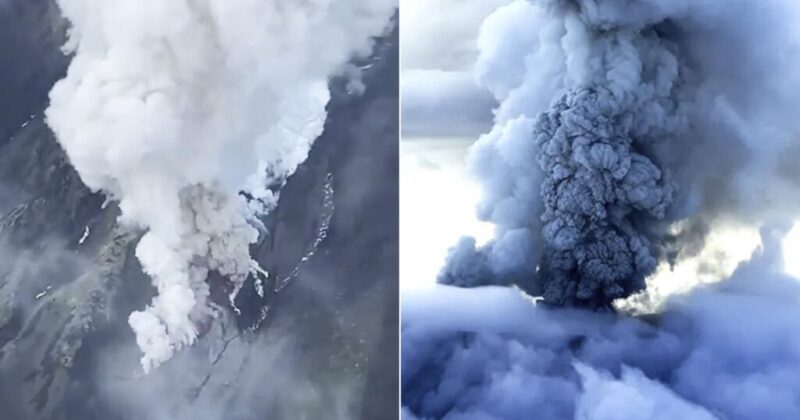
Less than a week after a powerful 8.8-magnitude earthquake shook Russia’s Far East and prompted tsunami alerts across the Pacific, the Krasheninnikov volcano in Russia’s Kamchatka Peninsula erupted on Sunday for the first time in centuries, spewing ash nearly 4 miles into the sky.
According to the Kronotsky Nature Reserve, the volcano released ash plumes reaching 6 kilometers (3.7 miles) high. Images shared by Russian state media showed thick columns of smoke rising above the crater, painting a dramatic picture of a region increasingly rattled by geological activity.
First Eruption in Nearly 500–600 Years
“This is the first historically confirmed eruption of the Krasheninnikov volcano in 600 years,” said Olga Girina, head of the Kamchatka Volcanic Eruption Response Team, in an interview with RIA Novosti.
However, the Smithsonian Institution’s Global Volcanism Program lists Krasheninnikov’s last eruption as occurring in 1550—about 475 years ago. The reason for the discrepancy was not immediately explained.
Despite the dramatic eruption, local authorities said the ash plume was moving eastward toward the Pacific Ocean and posed no threat to populated areas.
“There are no populated areas along its path, and no ashfall has been recorded in inhabited localities,” Kamchatka’s emergencies ministry stated.
Earthquake Triggers Tsunami Warnings
A 7.0-magnitude aftershock accompanied Sunday’s eruption, prompting tsunami warnings for parts of Kamchatka. Russia’s Ministry for Emergency Services later lifted the warnings, and no significant damage was reported.
The eruption follows last week’s 8.8-magnitude earthquake, which rocked eastern Russia and triggered tsunami advisories across the Pacific, including in:
Small tsunami waves were observed in some regions, but no major impacts were reported.
Ring of Fire on Alert
The Krasheninnikov eruption marks the second volcanic eruption in the region in a week, following renewed activity from Klyuchevskaya Sopka, another volcano on Kamchatka’s volatile landscape.
Observers note that the simultaneous earthquake and volcanic activity signal renewed movement along the Pacific Ring of Fire—the world’s most seismically active zone.
“Two volcanoes in one week. The Pacific Ring of Fire is wide awake,” wrote journalist Brian McDonald on X.
Continued Monitoring Underway
Officials say moderate explosive activity may continue, though volcanic intensity appeared to be declining as of Sunday evening. Monitoring teams remain on high alert as tremors and seismic instability persist throughout the region.
The events have renewed global attention on the Pacific’s seismic vulnerabilities, highlighting how quickly natural events can escalate across national borders and oceans.