

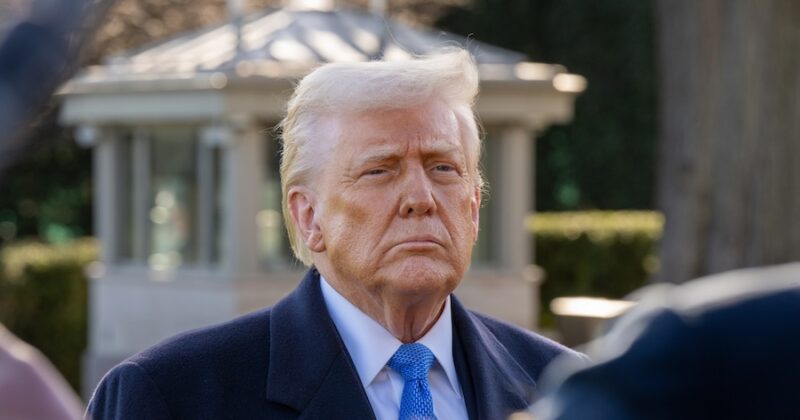
President Donald Trump on indicated on Tuesday that he will continue to pave the way for the reintroduction of mental hospitals as part of his broader agenda to combat homelessness.
Trump made the remarks while reflecting on his domestic agenda since he took office last January.
“Signed an executive order to bring back mental institutions and insane asylums. We are going to have to bring them back. Hate to build those suckers but you’ve got to get the people off the streets,” the president said in a press conference on the one year anniversary of his inauguration.
The order, titled “Ending Crime and Disorder on America’s Streets,” was signed this past January. It directs federal agencies, including the Departments of Justice, Health and Human Services (HHS), and Housing and Urban Development (HUD), to prioritize funding for states that ban public drug use, urban camping, and expand civil commitment laws.
Civil commitment allows courts to order involuntary treatment — either inpatient or outpatient — for individuals deemed a risk to themselves or others due to mental illness.
The order also instructs the Attorney General to seek reversals of judicial precedents, such as those stemming from the 1999 Supreme Court case Olmstead v. L.C., which emphasized community-based care over institutionalization under the Americans with Disabilities Act.
Additionally, it shifts away from “Housing First” models, which provide immediate housing without preconditions like sobriety, toward programs requiring treatment participation.
Trump has repeatedly stressed the importance of keeping disturbed individuals with mile-long arrest records off the streets. “And for those who are severely mentally ill and deeply disturbed, we will bring them back to mental institutions, where they belong, with the goal of reintegrating them back into society once they are well enough to manage,” he said while on the campaign trail in 2023.
Trump: Signed an executive order to bring back mental institutions and insane asylums. We are going to have to bring them back. Hate to build those suckers but you’ve got to get the people off the streets pic.twitter.com/wOPstcmQIj
— Acyn (@Acyn) January 20, 2026
This policy revives debates over the deinstitutionalization of mental health care in the U.S., which began in the 1950s and accelerated through the 1960s and 1970s. The peak of institutionalization occurred in 1955, with about 340 psychiatric hospital beds per 100,000 citizens.
Closures accelerated largely due to inhumane conditions within institutions, as well as the introduction of antipsychotic medications.
Supporters of Trump’s policy argue that deinstitutionalization has failed catastrophically, contributing to urban chaos, with untreated severe mental illness fueling homelessness, crime, and public disorder.
“Today, state hospital bed capacity is down more than 97 percent from peak capacity, adjusted for population. While the IMD exclusion remains in place, simply maintaining current bed capacity is often financially unworkable for states,” Manhattan Institute policy analyst Carolyn Gorman wrote.
