

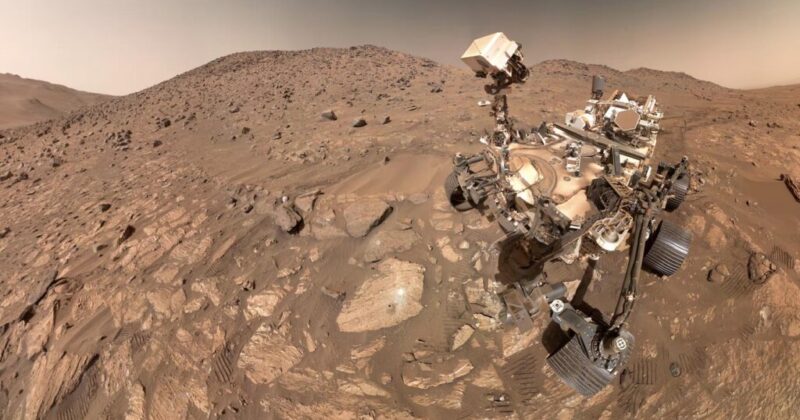
NASA scientists announced Wednesday that a Martian rock sample collected by the Perseverance rover shows what may be the clearest signs of ancient microbial life ever found on the Red Planet.
The findings come from Jezero Crater, an area that billions of years ago held a lake and river system.
Potential Biosignatures
“This is the kind of signature that we would see that was made by something biological,” said Nicky Fox, associate administrator for NASA’s Science Mission Directorate.
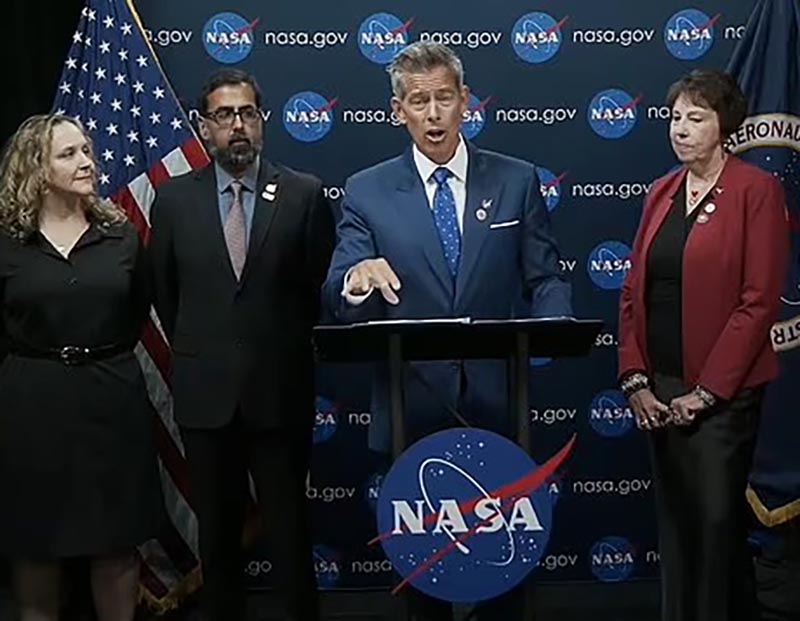
Fox clarified the agency is not announcing discovery of living organisms: “It’s not life itself.”
The rock sample, retrieved in July 2024, contains unusual dark “poppy seed” features and ring-shaped “leopard spots” that researchers say resemble biological activity seen on Earth.
Chemical analysis also revealed iron- and phosphorus-bearing compounds that can form when microbes break down organic material.

“This very well could be the clearest sign of life that we’ve ever found on Mars — which is incredibly exciting,” NASA Acting Administrator Sean Duffy said.
Joel Hurowitz, a planetary scientist at Stony Brook University and lead author of the peer-reviewed study in Nature, explained that the reactions observed in the rocks are similar to ones driven by microbes in Earth mudstones.
“The microbes are consuming the organic matter in these settings and producing new minerals as a byproduct,” Hurowitz said.
Still, he cautioned that non-biological chemical processes can produce similar results.
The Jezero Crater Site
The rover explored Neretva Vallis, an ancient river valley that once fed Jezero Crater.
Crystalline solids in the sample point to groundwater flowing through the region roughly 3.7 billion years ago.
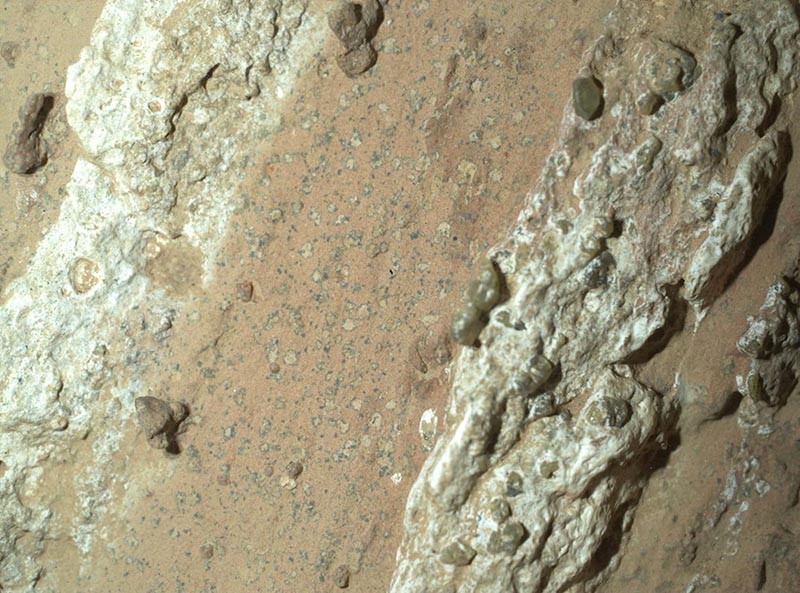
Bands of reddish hematite and white calcium sulfate veins suggest long-term water activity — essential for microbial life.
The rock, dubbed Sapphire Canyon, was drilled from the “Bright Angel” formation on July 21, 2024.
The rover sealed the core in a tube for potential return to Earth.
Perseverance has been collecting and caching samples since it landed in February 2021.
Next Steps
Scientists stress that only laboratory testing on Earth can definitively prove whether the Martian features are biological.
Until then, the samples represent a “potential biosignature” — structures or substances that may have a biological origin but need further study.
Duffy also highlighted upcoming Artemis missions. Four astronauts are scheduled to orbit the Moon early next year, followed by a lunar landing within 18 months.
“What we learn on the Moon will prepare us to put American boots on Mars,” he said.