

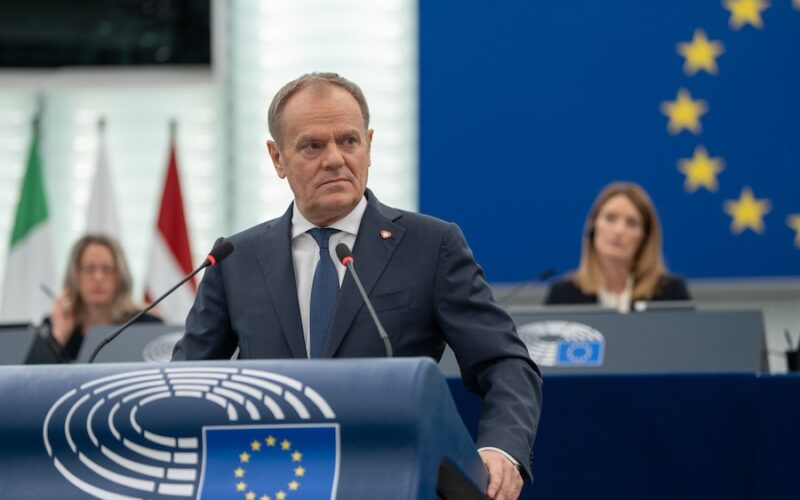
On Friday, Poland’s Constitutional Tribunal, the nation’s highest court for reviewing laws, suspended its president and deputy for a month. This decision ignited widespread protests, prompting critics of Prime Minister Donald Tusk to label it a “coup attempt.”
Judge Anna Korwin-Piotrowska announced she would take on temporary leadership, a move the Tribunal’s official account contested, insisting she is not a judge of the Tribunal and that those involved are committing a coup d’état.
This turmoil coincided with President Karol Nawrocki’s official trip to Senegal. He swiftly announced his return, stating, “At a moment like this, the president must be in Poland,” as he cut short his travels.
In Poland’s political framework, the president’s role is separate and critical, including the task of swearing in judges to the Tribunal, while the prime minister oversees day-to-day government operations.
POLL: Should Immigrants Be Required To Speak English?
Judicial coup in Poland by Prime minister & police tonight as Polish president was on a plane abroad
For everyone asking what's happening in Poland tonight, here are the key points:
1. The Constitutional Tribunal's leadership has been challenged. Judge Anna… pic.twitter.com/c2F3NnjsOX
— Brian McDonald B (@iamBrianBJ) October 30, 2026
The suspension followed months of political deadlock, where Tusk’s coalition elected new judges in 2026. President Nawrocki had refused to officiate the oaths for some judges due to procedural discrepancies, leading to those judges taking their oaths in parliament instead.
Tribunal President Bogdan Święczkowski, who was appointed by the previous Law and Justice (PiS) administration, barred these judges from participating in cases. Justice Minister Waldemar Żurek sought to lift the immunity of Święczkowski and his deputy to pursue legal actions against them for obstructing the new judges.
Tusk remarked that, “Restoring the rule of law is our duty,” highlighting the challenges of reversing what he deemed years of PiS misconduct. His government claims the previous judicial reforms led to partisan control of the Tribunal, conflicting with EU standards.
The Tribunal, under PiS, had ruled that Polish constitutional law supersedes some EU measures and maintained strict abortion laws. Tusk’s administration, which assumed power post-2023 elections, is attempting to overturn these policies and address disputes with the EU. After Korwin-Piotrowska reported security concerns, police were deployed outside the Tribunal in Warsaw.
Reports of objects being thrown at police were noted, though law enforcement did not enter the building itself. Święczkowski’s deputy faced access denial at the gates.
Thousands of Poles are now gathered in front of the Constitutional Tribunal building in Warsaw, which has been occupied by police sent by Donald Tusk's government.
Opposition figures are describing Tusk's actions as an attempted coup. pic.twitter.com/NcqYhJeeCl
— Europa.com (@europa) October 30, 2026
Protests erupted outside the court as PiS supporters voiced their discontent. Chants of “Tusk traitor” rang out, while others prayed with Catholic rosaries and religious imagery. PiS leader Jarosław Kaczyński was present, attempting entry and condemning the police presence as a sign that “from today, Poland is becoming a police state,” labeling the events a “coup” against the Tribunal.
Despite the turmoil, Tribunal leadership asserts Święczkowski and his deputy remain in their positions. Earlier, Święczkowski had filed a complaint leading to inquiries into Tusk and other officials, alleging a wide-ranging attempt to undermine constitutional bodies.
This ongoing crisis raises questions about the Tribunal’s functionality while the president returns, with opposition figures asserting that the suspension and police actions represent an illegal takeover of a constitutional institution.
