

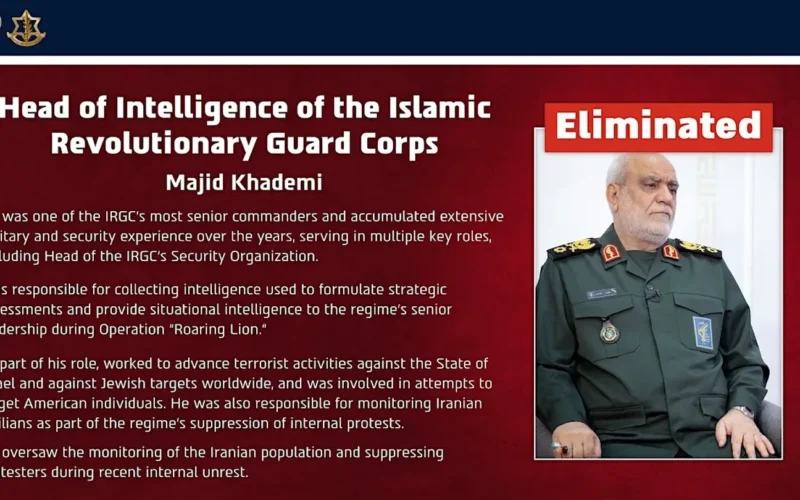
In a decisive move, Israel has eliminated a significant player in Iran’s intelligence community, marking a critical setback for Tehran’s security strategies.
The Israel Defense Forces confirmed the death of Brig. Gen. Majid Khademi, the intelligence chief of Iran’s Islamic Revolutionary Guard Corps, during a precise operation. Additionally, they indicated that special operations commander Asghar Bagheri may have been killed in the same strike, though this detail remains unverified.
An IDF statement on X highlighted Khademi’s involvement in developing terror schemes abroad and overseeing the surveillance of Iranian citizens amid regime crackdowns on dissent.
A senior Israeli official remarked, “Khademi represented a pivotal position in the IRGC, and managed to evade multiple targeting attempts by Israeli and American forces over the last year—until now.” This official also noted that Khademi’s intelligence operations had repeatedly failed to counter major Israeli and U.S. initiatives.
The same source indicated that Khademi was significantly involved in efforts to compromise U.S. systems, including initiatives aimed at infiltrating the Pentagon, and worked closely with Russian operatives.
“His elimination is a noteworthy strike against Iran’s intelligence leadership, occurring at a moment when the regime faces intense external pressure,” the official elaborated.
Although Bagheri’s death has not been officially confirmed, reports suggest he played a key role in recruiting agents throughout the Middle East and in orchestrating attacks against American interests in Iraq and Syria, leading to U.S. casualties.
With decades of experience, Khademi ascended through the ranks of Iran’s intelligence and counter-espionage sectors. Prior to his role as IRGC intelligence chief, he managed the Guard’s Intelligence Protection Organization, responsible for domestic surveillance and counterintelligence.
The IRGC’s intelligence capabilities are critically positioned within Iran’s security framework, charged with monitoring internal dissent and managing foreign threats, often in collaboration with the country’s other intelligence services.
