

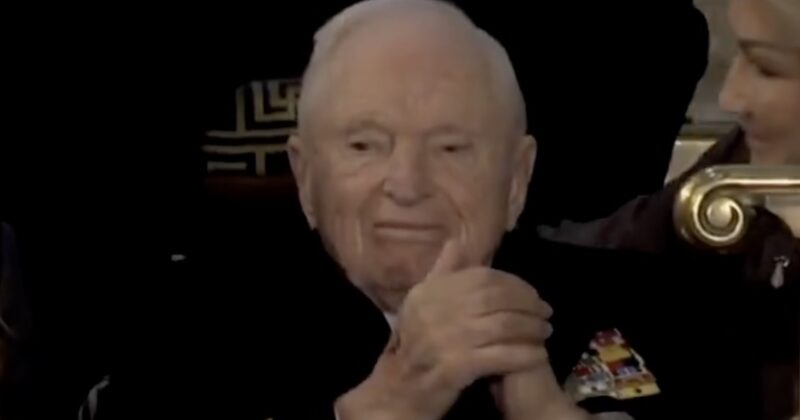
A moment meant to unite the country sparked controversy when Democratic commentators appeared to mock the honoring of a 100-year-old war hero during President Donald Trump’s 2026 State of the Union.
President Trump awarded the Medal of Honor to retired Navy Capt. E. Royce Williams, a Korean War veteran whose heroism stayed classified for decades.
Williams, a South Dakota native now living in San Diego, was honored for an extraordinary aerial engagement on November 18, 1952.
Flying an F9F-5 Panther from the USS Oriskany, Williams became separated from his wingman and engaged seven Soviet MiG-15 jets alone.
Over about 35 minutes, an unusually long dogfight by military standards, he shot down four enemy aircraft while returning a heavily damaged plane to the carrier.
His actions earned a Silver Star in 1953 and the Navy Cross in 2023 after the mission was declassified.
Congress later removed time limits on Medal of Honor eligibility for certain historic acts, clearing the way for his highest recognition.
At the State of the Union ceremony, Williams sat beside First Lady Melania Trump as she placed the medal around his neck while members of Congress gave a prolonged standing ovation.
MUST WATCH: At @POTUS‘ direction, @FLOTUS bestows 100-year-old Navy Fighter Pilot Royce Williams with the Congressional Medal of Honor for his actions during a secret 1952 mission in Korea, in which he downed four enemy jets while taking on tremendous fire ❤️🇺🇸 pic.twitter.com/ZnTewnCMfj
— Rapid Response 47 (@RapidResponse47) February 25, 2026
Democratic Reaction and Backlash
A video clip circulated showing several Democratic commentators discussing the moment in a dismissive tone.
One participant compared the ceremony to an “award show” and joked, “You get a medal, you get a medal.”
Another reportedly called the event “as horrific as I thought it would be” and said, “I left.”
Veterans’ groups and military families swiftly condemned the remarks as disrespectful to Williams and to service members broadly.
The controversy highlights how politics now often overshadows ceremonies meant to recognize genuine acts of valor.
Veterans and their advocates say respectful discourse is necessary to preserve the sanctity of honoring those who served.
For many Americans the focus remained on Williams’ long-delayed recognition of one of the most remarkable dogfights in U.S. military history.
Regardless of the political fallout, Williams’ record stands: outnumbered, outgunned, and flying a damaged aircraft, he prevailed.
At 100 years old he finally saw the nation formally acknowledge his courage.
