


Democrat-controlled Maryland is set to move forward with a plan to draw out its lone Republican-controlled district, a move that will further increase the likelihood of Democrats retaking control of the U.S. House later this year.
The effort began when Democrat Governor Wes Moore established the Governor’s Redistricting Advisory Commission in November 2025. Chaired by U.S. Sen. Angela Alsobrooks (D-MD), the five-member panel of Democrat appointees claimed it heard community feedback and reviewed proposals before voting to recommend new boundaries on December 18, 2025.
On Tuesday, following a closes-door meeting, the commission approved and recommended a specific new congressional map to Governor Moore and the Maryland General Assembly. The new map now awaits consideration and potential approval by the Democrat-controlled legislature, where it is likely to pass.
The new boundaries will draw out Maryland’s 1st Congressional District, which is currently represented by conservative Rep. Andy Harris (R-MD). In doing so, all eight of the state’s eight congressional districts will likely be controlled by Democrats following the November midterm elections.
U.S. Rep. Andy Harris speaks at CPAC Hungary in 2024
Photo: Elekes Andor
Historically, the state’s lone Republican-controlled district encompasses the rural Eastern Shore, including areas like the Delmarva Peninsula, and parts of Western Maryland. The current boundaries encompass several conservative municipalities, giving Republicans a stronghold in the otherwise Democrat-dominated state.
The proposed changes would redraw the 1st District by extending it across the Chesapeake Bay to incorporate portions of Anne Arundel and Howard counties, which are suburban and more Democrat-leaning areas near Baltimore and Washington, D.C. This reconfiguration would add substantial Democrat-leaning populations, diluting the conservative base on the Eastern Shore and Western Maryland, and making the district far more competitive or likely blue.
A court challenge appears highly likely if the legislature adopts the map. Republicans and experts have already signaled intent to sue, citing Maryland’s history of judicial intervention in redistricting.
In 2021-2022, a state court struck down a prior Democrat-drawn map as an “extreme partisan gerrymander.” The court ruled that the proposal violated the state’s constitution and ordered a redraw.
The current map, enacted in 2022, avoided further successful challenges. Legal experts and even some Democrats have expressed concern that a new map explicitly targeting the sole Republican district could face similar scrutiny for “extreme partisan gerrymandering,” potentially leading to the state losing in court.
State Senate President Bill Ferguson, a Democrat, who opposed the commission’s recommendation, has highlighted these risks, arguing mid-decade changes could undermine legal standing and potentially jeopardize Democrat holdings in other districts.
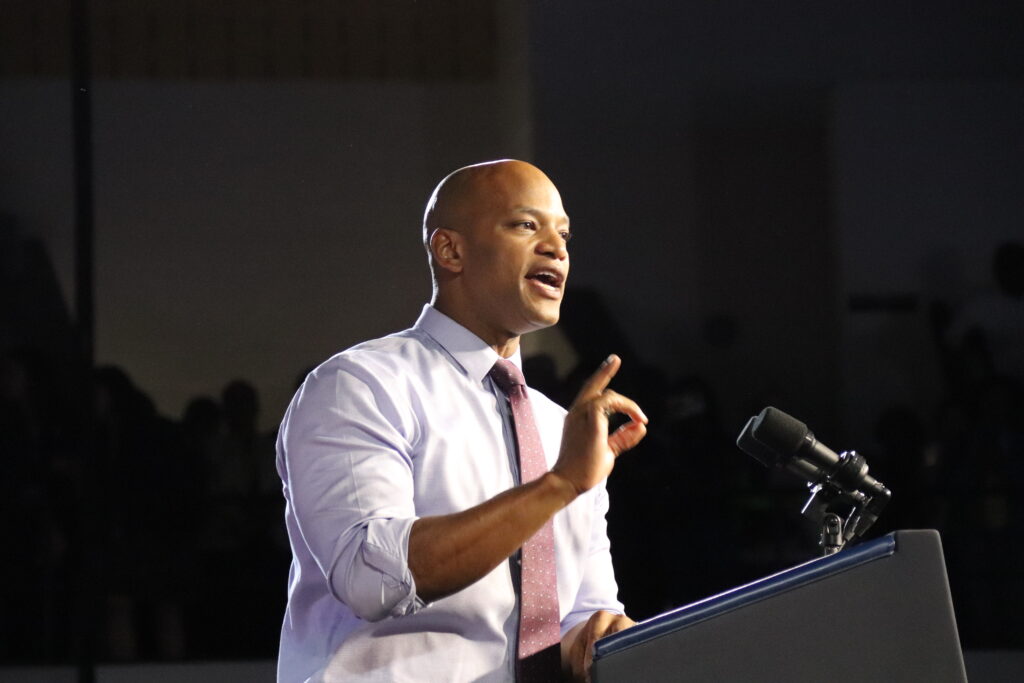
Maryland Governor Wes Moore speaks at a campaign rally on November 7, 2022
Photo: Elvert Barnes
The proposal comes just days after Virginia — a state Democrats carried by just under six percentage points in the 2024 presidential election — moved to advance a new map that will give Democrats a 10-1 split for control of the state’s congressional districts. The current split is currently 5-4 in favor of Democrats.
In order to be adopted, Virginia voters will need to adopt a constitutional amendment during a special election this April.
