

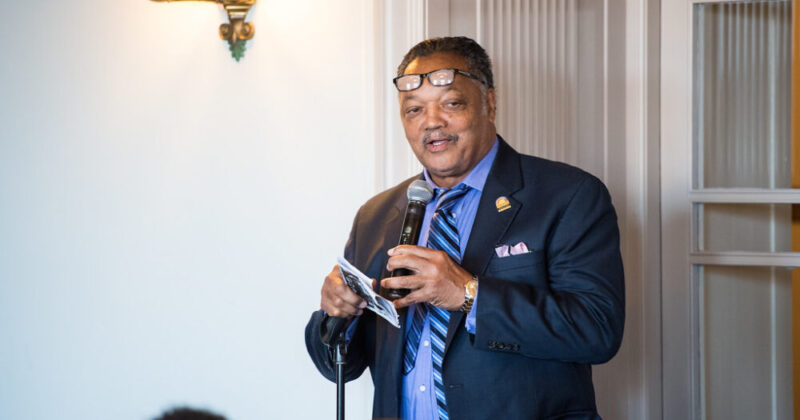
The Rev. Jesse Jackson, a towering figure of the civil rights era, two-time Democratic presidential candidate and founder of the Rainbow PUSH Coalition, died Tuesday morning at 84, his family said.
“It is with profound sadness that we announce the passing of civil rights leader and founder of the Rainbow PUSH Coalition, the Honorable Reverend Jesse Louis Jackson Sr. He died peacefully on Tuesday morning, surrounded by his family,” the statement said.
“Our father was a servant leader — not only to our family, but to the oppressed, the voiceless, and the overlooked around the world,” the Jackson family said. “We shared him with the world, and in return, the world became part of our extended family. His unwavering belief in justice, equality, and love uplifted millions.”
A cause of death was not disclosed. Jackson battled serious health challenges in recent years. He announced in 2017 that he had Parkinson’s disease and was later treated for progressive supranuclear palsy, a rare degenerative neurological disorder. Even as his voice and mobility weakened, Jackson remained active. He was arrested twice in 2021 during protests urging changes to the Senate filibuster rule.
4
President Donald Trump offered condolences Tuesday, calling Jackson a “fierce advocate” for civil rights and extending sympathies to the Jackson family. In a statement, Trump said the nation “mourns the loss of a historic American voice.”
Born Oct. 8, 1941, in Greenville, South Carolina, Jackson came of age in the segregated South. A strong student and athlete, he initially attended the University of Illinois on a football scholarship before transferring to North Carolina Agricultural and Technical College, graduating in 1964.
Jackson’s activism began early. At 18, he was arrested for taking part in a sit-in at a segregated public library, an episode that launched his ascent in the student-led movement challenging Jim Crow laws across the South.
After college, Jackson left Chicago Theological Seminary to work alongside the Rev. Dr. Martin Luther King Jr. in Selma, Alabama. He later rose within the Southern Christian Leadership Conference. Backed by King, Jackson led Operation Breadbasket in Chicago, pressing corporations to expand jobs and economic opportunities for Black Americans.
Jackson was in Memphis in 1968 when King was assassinated, a tragedy that reshaped the movement and Jackson’s own trajectory. He went on to found what became the Rainbow/PUSH Coalition, focusing on civil rights, voter registration and economic empowerment. Over decades, he collected dozens of honorary degrees and received the Presidential Medal of Freedom in 2000 from President Bill Clinton.
Jackson twice sought the Democratic presidential nomination. In 1984, he captured 18% of the primary vote. The campaign was overshadowed by controversy stemming from an antisemitic remark he made about New York’s Jewish community.
In 1988, Jackson mounted a stronger bid, winning nearly 7 million votes — about 29% of the total — and finishing first or second in several Super Tuesday contests. Massachusetts Gov. Michael Dukakis ultimately secured the nomination.
Though he never held elected office, Jackson remained a fixture in American politics. He championed expanded voter registration, advocated for Washington, D.C., statehood and at times served as an informal diplomatic envoy, including missions to secure the release of Americans detained overseas.
In 2001, Jackson publicly acknowledged that he had fathered a daughter, Ashley, with a woman affiliated with his advocacy organization. He later apologized.
Jackson is survived by his wife of more than 60 years, Jacqueline; their children — Santita, Jesse Jr., Jonathan, Yusef and Jacqueline — daughter Ashley Jackson; and grandchildren.
Public observances will be held in Chicago. Funeral arrangements have not yet been announced.
