

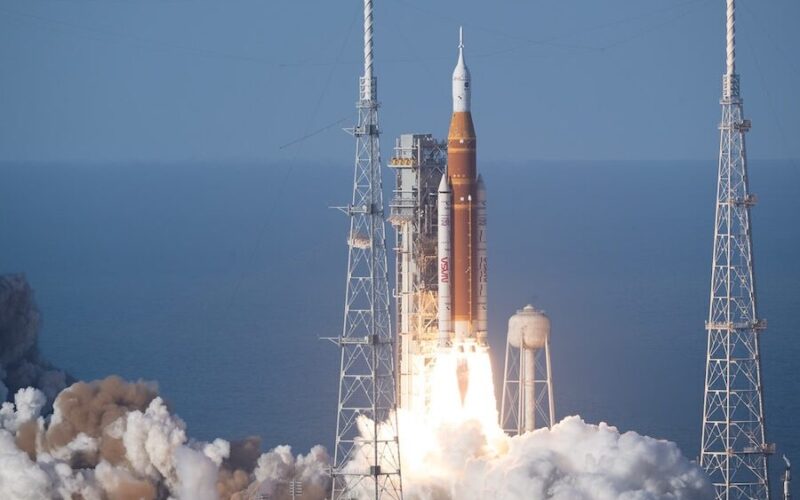
More than fifty years since the Apollo missions expanded the horizons of human space exploration, NASA’s Artemis II crew has officially traveled farther than ever before.
By orbiting the Moon, the Artemis II astronauts now hold the record for the longest journey into space by humans, eclipsing the Apollo 13’s distance of 252,000 miles from Earth. The Apollo 13 mission was marked by a near-disaster, but this mission is purpose-driven.
Under the command of Reid Wiseman, alongside pilot Victor Glover and specialists Christina Koch and Jeremy Hansen, this mission marks the first time since 1972 that a crewed mission has ventured beyond low-Earth orbit. Unlike the Apollo program, Artemis II is focused on ensuring the safety and functionality of NASA’s advanced space systems.
LIVE: Watch with us as the Artemis II astronauts make their closest approach to the Moon, traveling farther from Earth than ever before. https://t.co/Zpy7GdTqA8
— NASA (@NASA) April 6, 2026
During its flight trajectory, the crew faced a planned communications blackout of about 40 minutes as Orion moved behind the Moon. This moment not only echoed past challenges but also symbolized the dawn of a new exploration era.
The astronauts took the opportunity to document the Moon’s far side, revealing breathtaking views of its rugged terrain. As their spacecraft flew by, they glimpsed Earth rising above the lunar surface, cementing the distance traveled.
This historic flight is a significant achievement for NASA’s Artemis program, which aims to create a sustainable human presence on the Moon and subsequently send astronauts to Mars.
In contrast to previous missions, Artemis II assesses a myriad of systems essential for extended space travel. Engineers are closely monitoring various factors including life support systems and navigation accuracy, gathering invaluable data for future missions.
Artemis II is not just going “to the Moon,” but rather traveling to meet it at an exact point in space.
It’s all about orbital mechanics. pic.twitter.com/Gy4Dy5k8t9
— Massimo (@Rainmaker1973) April 6, 2026
The mission’s trajectory also showcases modern efficiency. After its lunar flyby, Orion will employ a gravity assist to return to Earth, optimizing fuel use while ensuring a controlled descent.
This mission holds personal significance as well; Christina Koch will make history as the first woman to travel this far into space, representing inclusivity in exploration alongside Jeremy Hansen—a nod to international collaboration in the Artemis venture.
For NASA, Artemis II connects the legendary Apollo missions to a promising future. While Apollo showcased the feasibility of lunar travel, Artemis is dedicated to establishing a permanent foothold on the Moon and charting pathways to even further destinations.
If all goes according to schedule, Orion will reenter Earth’s atmosphere and splash down in the Pacific Ocean this month, solidifying its historic achievement. For the first time, humans have intentionally surpassed the distance traveled during a moment of crisis in Apollo 13, marking a monumental step forward in space exploration.
