


Governor Ron DeSantis announced on Monday that he has officially signed a redistricting plan aimed at strengthening the Republican Party’s presence in Congress. This new map could potentially net the GOP up to four extra House seats in the upcoming elections.
This swift special session on redistricting wraps up a crucial effort, enabling GOP leaders to adjust district lines midway through the decade. The redrawn map is set to increase Florida’s Republican delegation from 20 to 24 seats, while the number of Democrat-held areas will decrease from 8 to 4.
In a triumphant declaration, DeSantis said, “Signed, Sealed, and Delivered,” via his social media channels.
Just a day prior, both chambers of the Florida legislature approved the new congressional map, demonstrating swift bipartisan discussions.
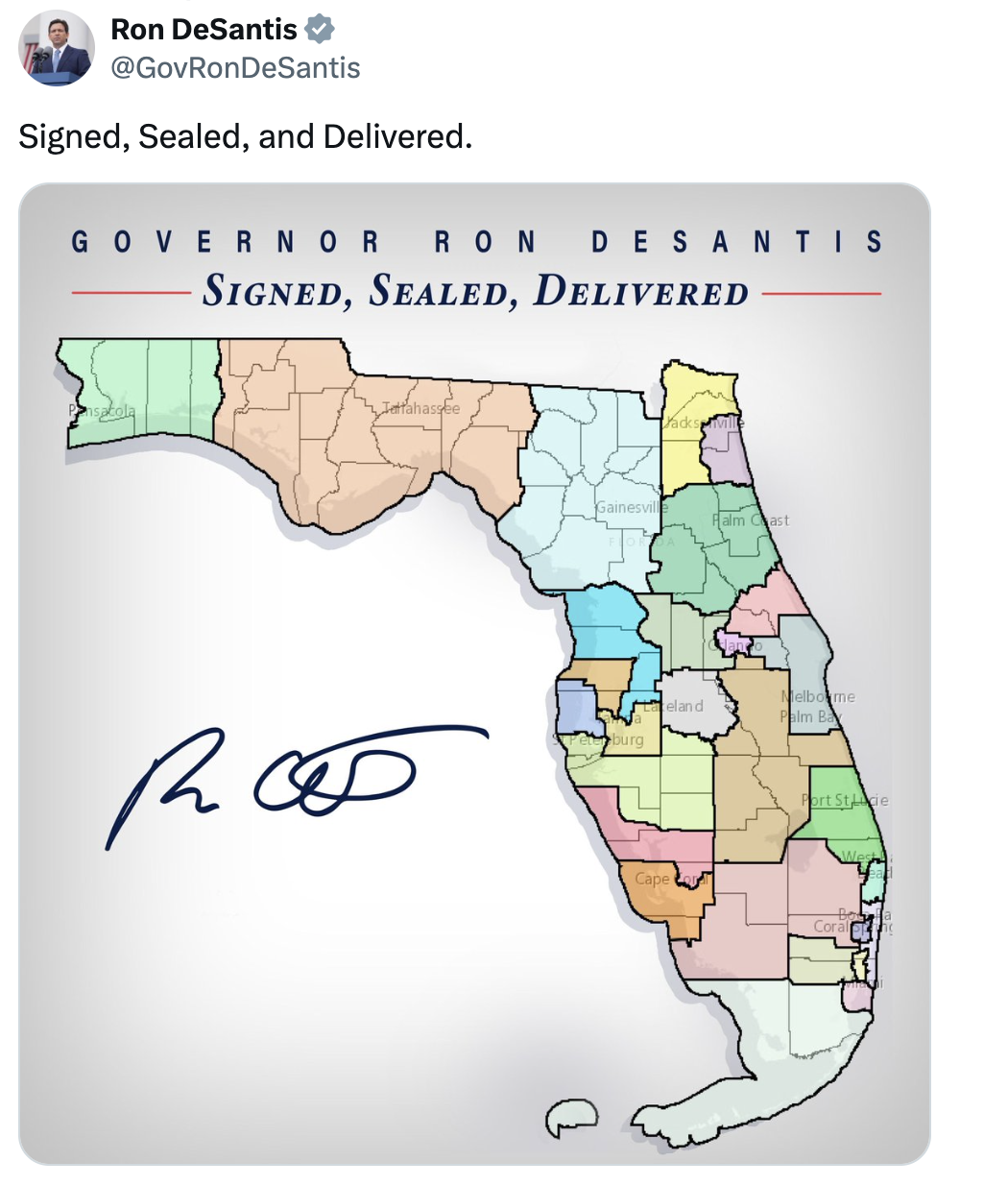
The changes in the map could adversely affect Democrats in crucial regions. The proposal directly targets the districts represented by Rep. Kathy Castor in Tampa and Rep. Darren Soto in Central Florida, while also reducing the size of Rep. Maxwell Frost’s district.
In South Florida, Republicans have strategically altered several districts that lean Democratic. Five Democratic-held seats could be consolidated into just three, impacting the political fortunes of Reps. Jared Moskowitz, Debbie Wasserman Schultz, Lois Frankel, and Frederica Wilson, among others.
RELATED: GOP Could Gain 19 Seats From Shock SCOTUS Ruling
However, the victory might be short-lived, as Democrats are preparing to challenge the new map legally, potentially setting off another contentious court battle over the state’s district lines.
The core of this upcoming legal struggle is a constitutional debate. DeSantis’s legal team argues that Florida’s constitution mandates considerations of race in redistricting, which they claim goes against judicial precedents established by recent Supreme Court decisions linked to the Voting Rights Act.
With the new map now in effect, both political parties anticipate a fierce legal and electoral battle as they gear up for the 2026 midterms.
