

On Wednesday, Iran heightened tensions in global shipping by targeting three commercial vessels near the critical Strait of Hormuz. This waterway is essential for energy supplies, making these incidents particularly concerning.
Since the conflict reignited on February 28, the total number of ships affected in the area has climbed to at least 14. Ongoing hostilities between Iran and both the United States and Israel have exacerbated this situation.
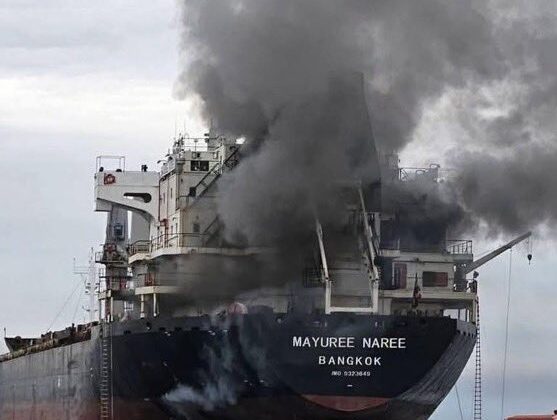
The most damaging strike involved the Thai-flagged bulk carrier Mayuree Naree, struck by two projectiles around 11 nautical miles north of Oman. Reports indicate that the attack caused a fire and damaged the engine room, as stated by Reuters.
According to the operator, Precious Shipping, three crew members are unaccounted for and presumably trapped. However, the remaining crew of 20 was safely evacuated and transported to Oman.
Visuals released by the Thai navy depict smoke enveloping the vessel, underscoring the dangers that commercial ships face in these treacherous waters.
Iran’s Revolutionary Guards have officially acknowledged that their forces engaged a commercial ship during this new phase of conflict. This pronouncement marks a notable escalation in confrontations.
In addition to the Mayuree Naree, two other vessels were attacked, albeit with less severe consequences. The Japanese container ship ONE Majesty was hit by a projectile about 25 nautical miles northwest of Ras Al Khaimah but remained operational and had all crew members safe.
Another vessel, the Star Gwyneth, flagged from the Marshall Islands, was damaged while anchored roughly 50 miles from Dubai but reported no injuries.
The ongoing attacks signal that the Strait of Hormuz is becoming an increasingly perilous route for merchant vessels. This corridor links the Persian Gulf with the Gulf of Oman and is crucial for global shipping.
The heavy military activity from the U.S. and Israel has led to substantial disruptions in maritime traffic. Approximately one-fifth of the world’s oil supply typically navigates through this strait.
Iran’s Revolutionary Guards have openly stated that any ships in the strait could be at risk as long as hostilities persist. Iranian officials have made threats to completely halt oil shipments from the region if attacks from the U.S. and Israel continue.
In response to these escalating tensions, oil prices have surged. Energy companies are adjusting shipping routes, and Saudi Aramco is diverting some tankers via the east-west pipeline to reach the Red Sea.
Although the U.S. Navy has been hesitant to provide escorts through this volatile region, President Donald Trump has indicated that America stands prepared to offer naval support if the situation worsens.
