

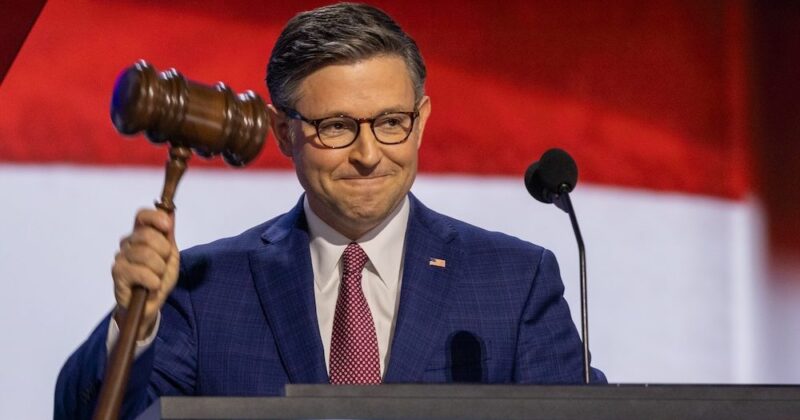
The end of the government shutdown came into view Tuesday as Speaker Mike Johnson muscled a fragile House GOP majority into advancing the Senate’s funding deal on Day 4 of the standoff.
The legislation cleared a crucial House-wide rule vote late Tuesday morning, opening the door for debate and a final passage vote later in the day. The razor-thin 217-215 tally capped a tense, hourlong scramble as Johnson worked to hold together a one-seat majority amid conservative blowback that nearly derailed the effort.
The breakthrough came after two House conservatives backed away from threats to torpedo the bill unless it was paired with the SAVE America Act, a voter integrity measure long demanded by the GOP base.
A rule vote is the House’s procedural gatekeeper, allowing lawmakers to debate a bill and move toward final passage. These votes typically track party lines, even when the underlying legislation has bipartisan support.
That dynamic held Tuesday. While House Minority Leader Hakeem Jeffries, D-N.Y., came out strongly against the funding deal, several Democrats are expected to support it on final passage. For Johnson, that meant threading the needle and keeping nearly every Republican in line.
Democrats previously walked away from a bipartisan House framework to fund the government through Sept. 30, rebelling over a Department of Homeland Security bill tied to President Donald Trump’s handling of unrest in Minneapolis. That collapse left roughly 78% of annual federal funding in limbo.
Under the new agreement between Senate Democrats and the White House, the remaining agencies will be fully funded through the end of the fiscal year, while DHS funding is extended only through Feb. 13 to buy time for further negotiations.
Despite broad GOP support, Reps. Anna Paulina Luna of Florida and Tim Burchett of Tennessee initially warned they would vote no without the SAVE America Act attached. The bill would mandate voter ID at the polls and require proof of citizenship for voter registration.
Attaching it would have sent the package back to the Senate, where Minority Leader Chuck Schumer, D-N.Y., declared it dead on arrival.
Luna said she and Burchett reversed course after assurances from the White House that Senate Majority Leader John Thune, R-S.D., would force a vote on the SAVE Act.
“As of right now, with the current agreement that we have, as well as discussions, we will both be a yes on the rule,” Luna said. “There is something called a standing filibuster that would effectively allow Senator Thune to put voter ID on the floor of the Senate. We are hearing that that is going well, and he is considering that…so we are very happy about that.”
Another flare-up followed when Rep. John Rose, R-Tenn., initially voted with Democrats to block the rule, citing doubts about Senate follow-through.
🚨@LeaderJohnThune is already backtracking on what he reportedly told some House Republicans: that if we reopened the government, he’d keep his word and bring the SAVE Act to the floor.
House Republicans MUST hold the line and refuse to fold on something as fundamental as… https://t.co/AYkQudcr7w
— Congressman John Rose (@RepJohnRose) February 3, 2026
“House Republicans MUST hold the line and refuse to fold on something as fundamental as election integrity,” Rose wrote on X. “The SAVE Act belongs on must-pass legislation.”
After closed-door talks with GOP leaders, Rose switched his vote. Only Rep. Thomas Massie, R-Ky., ultimately broke ranks.
With the rule adopted, the House moved into debate, setting up a final vote later Tuesday that could officially bring the shutdown to an end.
Download the FREE Trending Politics App to get the latest news FIRST >>
