

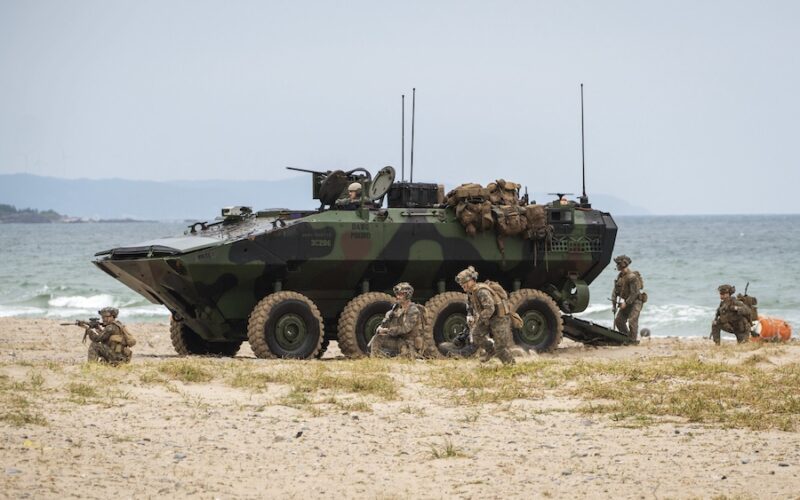
The Pentagon is ramping up its military presence in the Middle East with the deployment of an Amphibious Ready Group (ARG) alongside a Marine Expeditionary Unit (MEU), totaling around 4,000 service members. This contingent includes about 2,500 Marines specialized in amphibious operations, as reported by Newsmax.
According to unnamed U.S. officials, elements of the 31st Marine Expeditionary Unit from Japan and the amphibious assault ship USS Tripoli have been redirected to the region. This deployment is part of a larger reinforcement strategy that brings forward the Boxer Amphibious Ready Group and the 11th MEU from the West Coast.
The Boxer ARG consists of the USS Boxer, USS Portland, and USS Comstock, all equipped with advanced capabilities such as F-35 fighter jets, missiles, MV-22 Osprey tilt-rotors, and helicopters. As the USS Tripoli joins, the total number of amphibious ships may grow to six, potentially increasing troop presence by another 8,000, including 4,000 to 5,000 Marines.
War Secretary Pete Hegseth approved this move following requests from U.S. Central Command (CENTCOM), as noted in an Associated Press report.
Rapid-Response Capabilities
Marine Expeditionary Units are structured for swift amphibious operations, which include securing embassies, conducting evacuations, and providing disaster relief. These units possess an infantry battalion, aviation assets, and logistical support, enabling them to launch landing craft, aircraft, and small boats for various maritime security missions without needing a full ground invasion.
As reported by Military.com, this strategic deployment could enhance the Pentagon’s operational capacity against Iran while avoiding the large troop presence required for a full-scale ground invasion.
Though the deployment does not indicate an immediate large-scale ground operation in Iran, it grants military leadership flexibility around the strategically crucial Strait of Hormuz.
Political Context
Since the conflict reignited on February 28, additional ground troop deployments have been mostly limited and temporary. President Donald Trump has consistently emphasized that he does not plan to deploy ground troops for conflict resolution but has not dismissed the possibility.
This latest troop deployment follows a day after Israeli forces targeted strikes on Iran’s largest natural gas field, leading to subsequent retaliatory actions on energy infrastructure throughout the Gulf states. Trump has called for caution regarding energy targets but has left the door open for further strikes if U.S. and allied facilities come under attack.
