
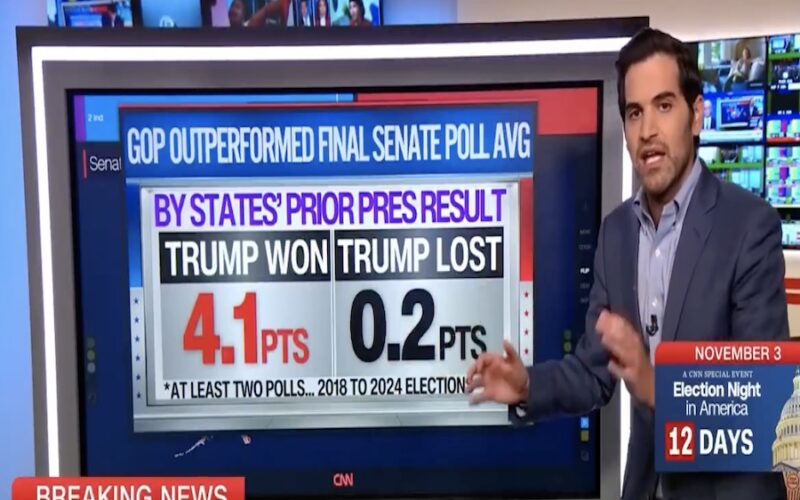
During a recent episode of CNN News Central, chief data analyst Harry Enten examined current U.S. Senate races as we approach the 2026 midterms. He highlighted polling averages in key contests and offered insights into historical trends linking polling inaccuracies to actual election outcomes in states won by President Donald Trump.
A graphic showcased that between 2018 and 2024, Republican candidates generally exceeded final Senate poll averages by 4.1 percentage points in Trump-supportive states. Conversely, in states that Trump lost, the average difference was a mere 0.2 points, based on races with a minimum of two polls.
Enten pointed out that this trend has remained steady in recent election cycles, particularly in states where Trump secured his victories.
His poll analysis revealed tight races in states where Trump had a significant win in 2024. These findings included a dead heat in Kansas, a one-point Democratic lead in Iowa, two points in Maine, three points in both Texas and Michigan, and a four-point Democratic edge in Ohio. Additionally, Alaska showed a Democratic lead of about three points.
The Democrats would need to secure a majority in these competitive races to gain Senate control, and many of the margins are within typical polling error ranges.
POLL: Will You Support Trump And His Candidates In The Midterms?
CNN: The GOP outperform senate polls in Trump states by an average of 4.1 points
If that counties
OhioDem +4 ->
GOP +0.1
Michigan
Alaska
Texas
Iowa
KansasTied ->
— OSZ (@OpenSourceZone) October 23, 2026
Enten then speculated on the implications if the 4.1-point average outperformance trend in Trump-won states were to repeat itself. Adjusting current averages could result in shifts like moving Ohio from a four-point Democratic lead to a slim 0.1-point Republican edge. Michigan could shift from a three-point Democratic lead to a one-point Republican edge, while a similar pattern could follow for Alaska and Texas. Iowa and Kansas could see changes leading to a Republican advantage as well.
This scenario could see Republicans maintain Senate control with a 52-48 margin, successfully holding onto seats in Michigan, Ohio, Texas, and Alaska.
Enten emphasized that while Democrats are presently ahead in the polling averages, a match between these averages and the results on Election Day would favor them. He reiterated the historical pattern of Republican outperformance in Trump-won states and indicated that the outcome may ultimately hinge on polling accuracy this cycle.
He noted the average error rate of around 3.7 points in tight Senate races, acknowledging that many current contests fall within this margin.
