

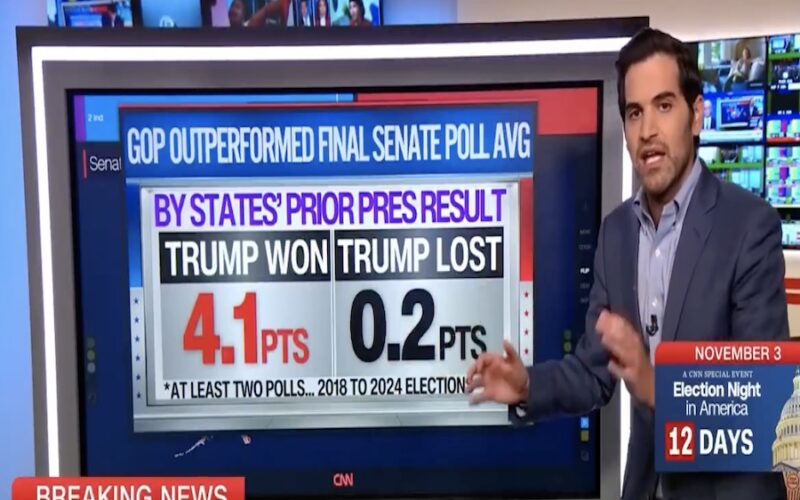
A recent discussion on CNN News Central by chief data analyst Harry Enten shed light on the competitive landscape of U.S. Senate races for the 2026 midterms. He emphasized the discrepancies between current polling averages and historical outcomes in states that supported President Donald Trump.
A graphic shared during the segment illustrated that from 2018 to 2024, Republican candidates exceeded final Senate poll averages by an average of 4.1 percentage points in Trump-supporting states, compared to a mere 0.2 points in those he lost. This data is drawn from races featuring at least two polls.
Enten pointed out that this pattern has been notably consistent, particularly in states that Trump won, rather than those he did not.
His aggregation of recent polling revealed tight races in states where Trump enjoyed significant victories in 2024, including a tie in Kansas, a Democratic lead of a single point in Iowa, and slim leads for Democrats in Maine, Texas, Michigan, and Ohio. Alaska also indicated a narrow Democratic advantage.
For Democrats to take Senate control, they would need to prevail in most of these races, many of which lie within typical margins of polling error.
POLL: Will You Support Trump And His Candidates In The Midterms?
CNN: The GOP outperform senate polls in Trump states by an average of 4.1 points
If that counties
OhioDem +4 ->
GOP +0.1
Michigan
Alaska
Texas
Iowa
KansasTied ->
— OSZ (@OpenSourceZone) October 23, 2026
Enten examined the potential consequences if the historical 4.1-point outperformance were to recur in Trump-won states. Adapting the current polling averages would turn Ohio’s four-point Democratic lead into a 0.1-point Republican edge, and similarly alter leads in Michigan, Alaska, Texas, Iowa, and Kansas, with Republicans gaining substantial advantages.
If this scenario unfolds, Republicans could maintain Senate control with a 52-48 margin, securing seats in Michigan, Ohio, Texas, and Alaska.
Despite current Democratic leads, Enten underlined that matching these averages with actual election outcomes could prove critical. He reiterated the historical trend of Republican outperformance and the uncertain impact of polling accuracy this cycle.
He acknowledged an average error rate of approximately 3.7 points in close Senate races, noting that many current contests fall within this margin.
