

A narrative of a looming “blue wave” just hit a wall — and it came from inside CNN.
During a segment breaking down the 2026 gubernatorial map, CNN data analyst Harry Enten delivered a “wake-up call for Democrats,” pointing to race ratings that currently tilt in Republicans’ favor across the country.
“I think electoral races nationwide should stand as a wake-up call for Democrats,” Enten said. “A wake-up call for Democrats.”
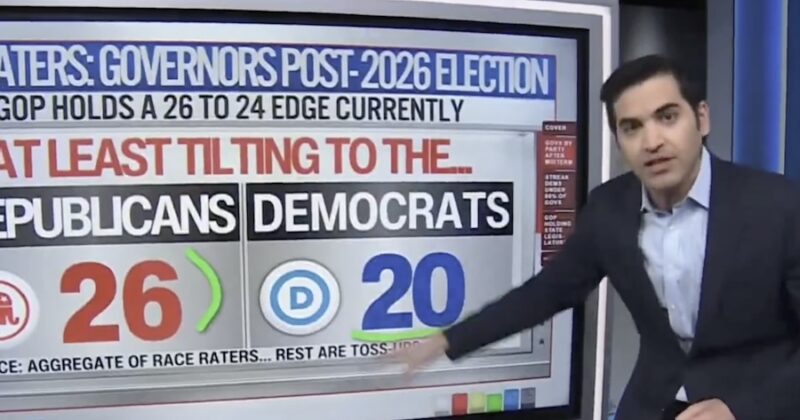
Enten directed viewers to the latest race ratings for governors following the 2026 elections. According to the projections he cited, 26 gubernatorial races are currently at least tilting toward the Republican Party, compared to 20 that tilt Democratic. The remaining contests are considered toss-ups.
“Look at this. A majority. A majority. Twenty-six,” Enten emphasized, underscoring the GOP’s edge in the current outlook.
Republicans already hold an advantage in gubernatorial offices nationwide, and the new projections suggest that advantage is unlikely to shrink. In fact, Enten noted that the GOP does not appear poised to lose ground on net — and could potentially expand its control when toss-up races are factored in.
“At this point, it doesn’t look like Republicans on the net and the aggregate are actually going to lose any governorships,” Enten said. “In fact, when you add in those toss-ups, they may gain.”
WATCH:
🚨 HOLY CRAP! CNN just sounded the alarm for Democrats predicting a “blue wave,” saying Republicans stand to GAIN more governorships nationwide and add to their majority
“Governors post-2026, 26 tilting Republican, a MAJORITY. Democrats at just 20…it doesn’t look like… pic.twitter.com/AgL7xWSwTL
— Eric Daugherty (@EricLDaugh) February 18, 2026
That assessment cuts sharply against the broader Democratic messaging that momentum is building at the national level. While some party strategists have floated the idea of a “blue wave” forming ahead of 2026, Enten’s analysis suggests that — at least at the state executive level — such a surge has yet to materialize.
“If there’s a wave building, it has not, at least at this point, hit the state level when it comes to governorships,” Enten concluded.
Governorships play a critical role in shaping policy, overseeing state-level implementation of federal laws, and influencing redistricting battles. They also serve as key power centers ahead of presidential cycles, helping to build party infrastructure and voter mobilization networks.
The gubernatorial elections are shaping up to be a major battleground across the country, with 36 states and three territories holding governor races on November 3, 2026. A large number of incumbents are term-limited or not seeking reelection, creating open seats and competitive contests that could shift partisan control in several key states. Overall, there’s a nearly even balance of governors heading into the cycle, with around 26 Republicans and 24 Democrats, and each party will be defending and contesting high-stakes races nationwide
Several states are considered battlegrounds where either party could win. Key open races include California, Michigan, Minnesota, Nevada, and Wisconsin, with governors in those states not seeking reelection and both parties targeting them closely.
Other competitive governorships include Arizona, where the Republican primary recently narrowed after a major candidate suspended her campaign, and South Carolina, where the Republican nomination to replace Gov. Henry McMaster is attracting significant attention. In New York, incumbent Gov. Kathy Hochul is running for reelection against a Republican challenger endorsed by national figures, making that contest one to watch even in a traditionally Democratic state.
For Democrats hoping for a sweeping reversal of Republican dominance at the state level, the numbers presented on CNN suggest the climb may be steeper than anticipated.
And coming from a network often seen as sympathetic to Democratic narratives, the warning carried added weight.
If a “blue wave” is on the horizon, it has yet to break on America’s gubernatorial map.
