

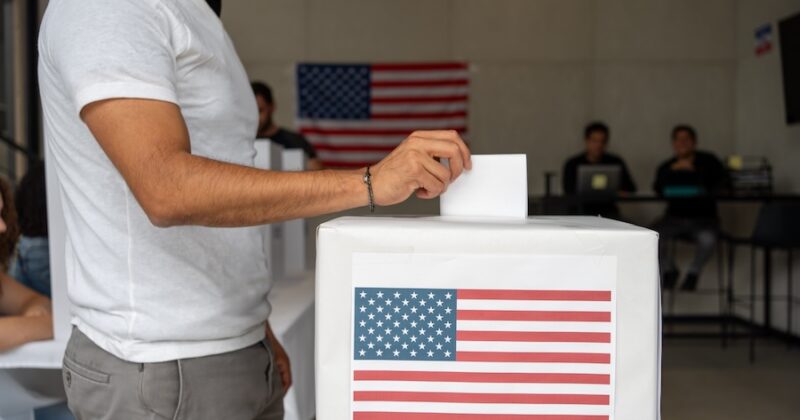
On Thursday the U.S. Court of Appeals for the Fifth Circuit has upheld Texas’ ban on ballot harvesting, reversing a lower court ruling that had struck the provision down.
The case stems from a years-long legal fight over Texas Senate Bill 1, the election reform measure passed in 2021. Civil rights groups, including La Union del Pueblo Entero (LUPE), challenged the law in La Union del Pueblo Entero v. Abbott, arguing that multiple provisions violated the Constitution, the Voting Rights Act and federal disability protections. Among the most contested sections was the state’s prohibition on compensated ballot harvesting.
Ballot harvesting is the practice of allowing a third party to collect and return completed mail in ballots on behalf of voters. Instead of the voter personally mailing or delivering the ballot to election officials, someone else such as a family member, caregiver, campaign worker or volunteer handles that step. Laws on ballot harvesting vary by state, with some allowing it broadly and others restricting or banning paid ballot collection altogether.
A federal district court had previously ruled that the ballot harvesting ban violated the First Amendment. But on February 12, the Fifth Circuit reversed that decision. In its ruling, the appellate court made clear that the lower court’s judgment could not stand, writing that “the judgment of the district court is REVERSED.”
The provision at issue makes it illegal to receive compensation for collecting or delivering ballots on behalf of voters. The Fifth Circuit’s decision is consistent with several prior rulings in the same litigation where the appellate court sided with Texas.
Over the past two years, the Fifth Circuit has reversed district court orders compelling production of legislative communications, upheld Texas’ ID number requirement for absentee ballot applications and envelopes, and affirmed provisions requiring ballot assisters to disclose information and take an expanded oath under penalty of perjury. In earlier decisions, the court also rejected arguments that Texas’ compensation ban was preempted by Section 208 of the Voting Rights Act.
Republican organizations, including the Harris County Republican Party, Dallas County Republican Party, National Republican Senatorial Committee and National Republican Congressional Committee, had intervened in the lawsuit to defend S.B. 1 after the district court initially denied their request to participate. The Fifth Circuit previously ruled that these groups had a right to intervene, finding that enjoining the law could harm their electoral interests.
Still, the Fifth Circuit’s latest move significantly strengthens Texas’ position. With the ballot harvesting ban now upheld, S.B. 1 remains largely intact as litigation continues. For election integrity advocates, the decision marks a major win in the national battle over voting laws and the rules governing how ballots are collected and returned.
Activity surrounding ballot harvesting laws has accelerated at both the federal and state levels heading into the 2026 election cycle. In Congress, several Republican lawmakers have introduced proposals aimed at restricting or penalizing the practice, including the “No Funds for Ballot Harvesting Act,” which would withhold federal election funds from states that allow third-party ballot collection.
Other broader election integrity bills, such as the SAVE Act and the MEGA Act, seek tighter voter identification and citizenship verification rules, though ballot harvesting is not always their sole focus. None of these federal measures have been enacted into law, and most remain in committee stages.
At the state level, legal battles and enforcement actions continue to shape the landscape. In Mississippi, a woman convicted under the state’s ballot collection restrictions is appealing her case, drawing attention to how narrowly the law defines who may return absentee ballots on behalf of others. Meanwhile, a federal lawsuit in South Carolina challenges that state’s absentee ballot return limits, arguing the restrictions burden elderly and disabled voters.
Ballot initiatives and election reforms are also influencing the debate. In 2025, Maine voters rejected a ballot measure that would have imposed stricter voter ID requirements and tightened absentee voting rules. Nevada voters are set to consider a constitutional voter ID amendment in 2026, which, while not directly banning ballot harvesting, intersects with ongoing concerns about mail voting oversight.
Currently, roughly three dozen states allow some form of ballot collection, though the rules vary widely. Some states permit only close family members or caregivers to return ballots, others cap the number of ballots one person may collect, and several prohibit paid ballot collectors altogether.
