

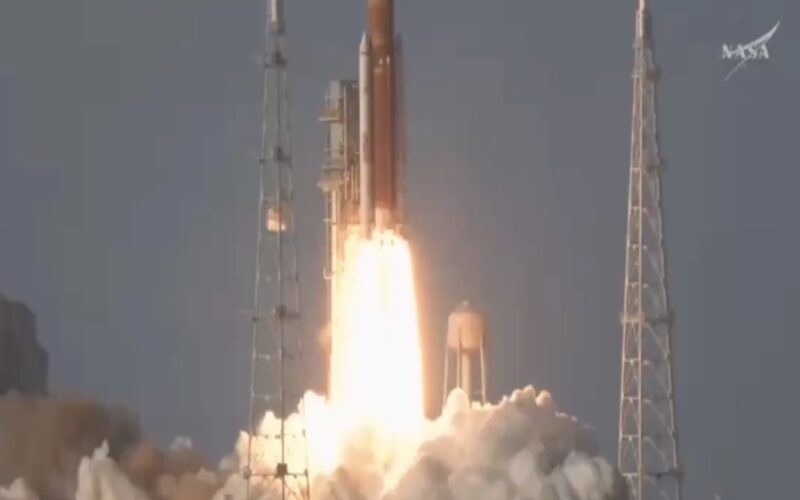
The highly anticipated Artemis II lunar mission successfully took off from NASA’s Kennedy Space Center in Florida on the evening of April 1, 2026. This marks a significant milestone, as it is the first human mission beyond low Earth orbit since the Apollo 17 mission in 1972.
The Space Launch System (SLS) rocket, towering at 322 feet, delivered over 8.8 million pounds of thrust at liftoff.
The launch window opened at 6:24 p.m. Eastern Time and proceeded smoothly. Crowds gathered in Cape Canaveral to witness the historic moment, while the international crew made their way to the launch pad.
By approximately 6:30 p.m. Eastern Time, the rocket successfully launched. A NASA official remarked, “Bound for the moon, humanity’s next great voyage begins,” as liftoff occurred.
Artemis II is the second mission in NASA’s Artemis program and the first crewed flight utilizing the SLS rocket and Orion spacecraft. The mission will send four astronauts on a lunar flyby, allowing critical testing of spacecraft systems in deep space prior to future lunar landings.
While the later Artemis missions will involve landings on the Moon, Artemis II is dedicated to validating the Orion craft’s capabilities with a crew, focusing on life-support systems, navigation, and reentry functionalities. This mission builds on the successes of the uncrewed Artemis I test flight from 2022.
The crew includes NASA astronauts Commander Reid Wiseman, Pilot Victor Glover, and Mission Specialist Christina Koch, alongside Canadian Space Agency Mission Specialist Jeremy Hansen. Their tasks involve systems checks and monitoring spacecraft performance, including a proximity operations demonstration with the Interim Cryogenic Propulsion Stage.
Once in orbit, crew members will conduct multiple checks on Orion’s life-support systems and navigation equipment. After staying in Earth orbit for about one to two days, the Interim Cryogenic Propulsion Stage will perform the trans-lunar injection burn, setting Orion on a free-return trajectory around the Moon, as detailed in NASA’s mission summary.
The spacecraft will make its closest approach to the Moon four to five days post-launch, passing the far side before starting its return journey, which will set a new record for human distance traveled from Earth.
This return route smartly uses the Moon’s gravity to assist Orion back to Earth, requiring no significant propulsion burns after the initial injection.
The complete mission is projected to last about 10 days, culminating in a splashdown on April 10, 2026, in the Pacific Ocean near California’s coast. During reentry, Orion’s service module will detach from the crew module, which will plunge through Earth’s atmosphere at speeds nearing 25,000 mph before parachuting down for recovery by NASA teams.
Throughout this mission, the astronauts will assess Orion’s capability to sustain human life during extensive deep-space missions, including monitoring cabin pressure, temperature control, radiation levels, and overall crew comfort. The data gathered will aid in making design improvements for upcoming Artemis missions, which aim to land astronauts on the Moon by the late 2020s and facilitate long-term exploration goals.
