

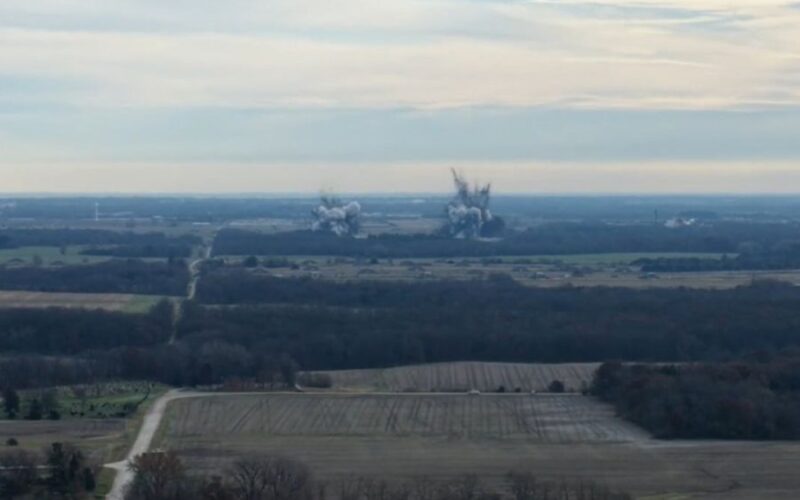
A controlled explosion involving nearly 10,000 pounds of explosives took place Wednesday morning at the Iowa Army Ammunition Plant, raising alarms about possible toxic lead dust affecting local areas.
The incident occurred around 9 a.m. Central time, aimed at destroying volatile lead azide after safety concerns prompted urgent action. Residents several miles away felt the shock wave from the blast, emphasizing its power.
In the wake of the explosion, the primary worry focuses on the aftermath and whether dangerous lead particles escaped the specified containment. Federal authorities have commenced investigations to evaluate any contamination that may have spread beyond military grounds.
Prior warnings were issued by the Army regarding the unstable nature of the materials, urging the destruction under controlled conditions rather than risking potential accidental detonations.
This operation utilized C-4 explosives and specialized charges, all strategically arranged in reinforced concrete structures.
NOW: The exact moment of PLUMES FORMING as the US Army detonates unstable lead azide in Iowa
They had INTENSE safeguards to block as much lead dust as possible from flying up and impacting nearby areas
The Army said it could have exploded on its own at any time. This was the option against an unplanned, uncontrolled detonation
— Eric Daugherty (@EricLDaugh) November 25, 2026
Col. Aaron Teller noted that the setup was designed to direct much of the force downwards, with diesel fuel helping ensure the complete destruction of the lead azide. Despite these precautions, residents observed a noticeable plume emerging after the explosion.
Hearing the blast, residents from New London, located about ten miles away, felt the reverberations. KWQC-TV’s reporter Cyle Dickens witnessed the event and described the dual plumes visually rising from the site.
While the presence of a plume raised concerns, it does not automatically confirm that hazardous lead concentrations have spread. Federal monitoring teams are actively assessing the situation, including projections of wind patterns that might carry any contaminants southwest toward Missouri.
Officials aimed to track the plume’s movement until approximately 2 p.m. Central time. Residents in Middletown and within a five-mile radius were advised to evacuate temporarily, while others in surrounding areas were urged to stay indoors for up to 48 hours.
This guidance could force families to stay inside through Thanksgiving as the situation unfolds. Just an hour before the blast, evacuation alerts were sent to Middletown residents, informing them that it was no longer safe to leave their homes.
Not every witness reported the explosion as intensely felt. Journalist Jim Mertens described it as less powerful than expected, comparing it to distant gunfire, while others noted a smell of gunpowder lingering in the air miles away.
As assessments continue, early reports suggested minimal immediate damage, but officials cautioned that the evaluation of any lead contamination could take time. EPA Administrator Lee Zeldin remarked that initial feedback indicated the military’s precautions have been effective.
Meanwhile, NASA is utilizing satellite imagery to monitor the plume, ensuring thorough evaluations are conducted regarding potential hazardous particle dispersion beyond the military site. Army explosives teams are also preparing drone inspections to confirm the successful destruction of all barrels.
My drone video of the #Iowa detonation moments ago. #detonation #army https://t.co/CNnbJ8sgwo
— James Wilson (@nmjameswilson) November 25, 2026
While the immediate aftermath seems to result in no substantial damage, questions persist about whether the operation inadvertently released toxic materials into the environment.
As Iowa residents approach Thanksgiving, the critical factor will be the outcome of ongoing environmental assessments.
