

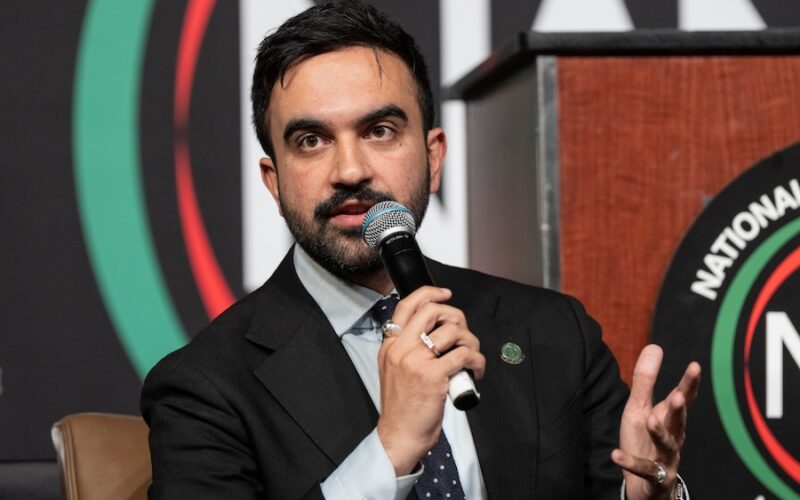
In a bold move, Mayor Zohran Mamdani announced the dissolution of the NYPD’s Strategic Response Group on Monday. This change aims to establish a civilian-led division centered on managing protests while enforcing stricter regulations on police crowd-control methods.
Marking a fulfillment of his campaign promise, Mamdani, in partnership with Police Commissioner Jessica Tisch, emphasized the need to separate counterterrorism efforts from protest management.
This decision comes after Tisch revealed that the Strategic Response Group predominantly dealt with violent demonstrations, rather than peaceful protests.
At a recent budget meeting, Tisch indicated that the NYPD facilitated a staggering 4,255 protests in 2025, with the SRG involved in only 245 of those, approximately 6%.
The mayor previously committed to dismantling the SRG during his campaign.
“I pledged to New Yorkers that we would break apart the Strategic Response Group and distinguish counterterrorism from protest activities. We are following through on that promise today,” Mamdani stated.
He further asserted, “New Yorkers exercising their constitutional right to protest deserve a different response than what is applied to terrorism threats. We are putting into place a civilian-led model that prioritizes dialogue, engagement, and de-escalation.”
New regulations will prohibit officers from using kettling, long guns, or tear gas in response to protests. Additionally, pepper spray will be restricted, and the use of “long-range acoustic devices” will be limited to 90 decibels.
The revamped framework delegates duties between a civilian office and two police teams.
The new Community Dialogue and De-escalation Division, located within the Mayor’s Office of Community Safety, will work alongside the NYPD’s First Amendment Support Team to manage protest responses.
According to City Hall, these reforms are intended to enhance the NYPD’s ability to respond to protests via a dedicated “dialogue team.”
“The CDDD will not possess weapons or arrest powers. FAST will consist of 30 uniformed officers skilled in communication and de-escalation techniques. Additionally, a new Patrol Support Division will be established, comprised of vetted officers focusing on patrol-related responsibilities and specialized crowd management training,” the mayor’s office reported.
We are disbanding the SRG. https://t.co/VRMUiSQlxY
— Mayor Zohran Kwame Mamdani (@NYCMayor) November 16, 2026
The announcement detailed that the Patrol Support Division will make arrests at protests when required, with the FAST managing communication and de-escalation during this phase.
Responsibilities previously held by the SRG regarding counterterrorism, including the deployment of heavy weapons to protect critical sites, will transition to the NYPD’s Intelligence and Counterterrorism Bureau.
This extensive restructuring alters a unit that had various responsibilities beyond protests.
The NYPD regarded the SRG as a “critical asset” for parades, large demonstrations, and significant public events. Officers from this unit also responded to civil unrest and other significant occurrences needing rapid intervention.
Furthermore, SRG personnel were dispatched to areas where increased police presence was necessary due to rising crime rates or other factors.
According to the department, the unit was also activated for shootings, bank robberies, missing persons, demonstrations, and various other noteworthy incidents.
