

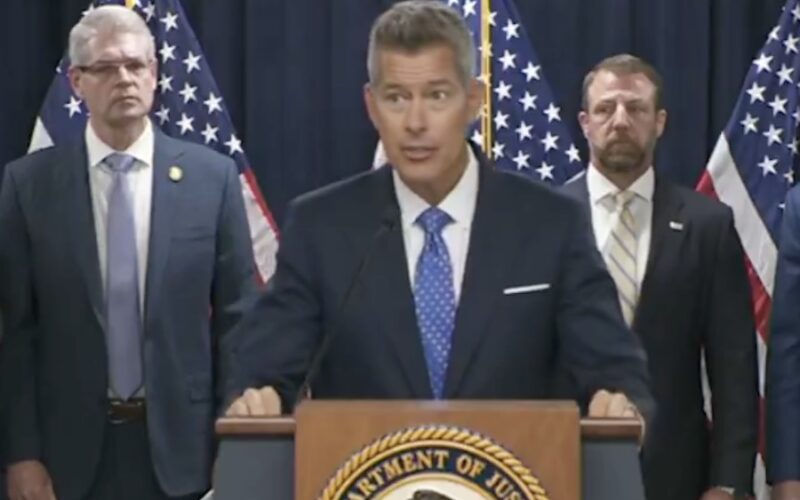
Transportation Secretary Sean Duffy provided insights today regarding the nationwide flight ground stop that occurred on Friday. The delay, which began at 3:36 p.m. Eastern Time, was triggered by issues affecting radar and communication systems across the country.
The Federal Aviation Administration (FAA) implemented the ground stop due to instability in communications and radar data linked to outdated infrastructure. Duffy explained how this instability resulted in inconsistent data from radar systems and disrupted communication with aircraft.
“At 3:36 p.m., we experienced instability for our radar and our communications and our centers and our TRACONs across the country. So, at airports we have towers. The next rung out is a TRACON. After that, we have En Route Centers. At the TRACONS and the centers, we started to have inconsistency in the data from the radars and our communication with airplanes,” Duffy said during Saturday’s press conference.
At the incident’s peak, over 3,500 flights were airborne when the order was issued. Duffy remarked that they managed to reduce the number of planes in the airspace to below 400, as they safely landed. The FAA confirmed that while some radar and telecommunications went down, critical flights for medevac, cargo, and law enforcement still proceeded.
The ground stop was lifted by 8:15 p.m. Eastern Time, following the restoration of functionality at the affected centers and TRACONs.
POLL: Will America Regret Giving The Democrats Power?
BREAKING: Transportation Secretary Sean Duffy says investigators are examining whether a contractor error or a faulty router caused a failure in the nation's air traffic control system.
Duffy says the problem emerged during an upgrade from copper to fiber, when a router being… pic.twitter.com/0jpH52PzMU
— Fox News (@FoxNews) November 14, 2026
Duffy cited failure in the antiquated analog telecommunications equipment as a significant cause. “What we have is an incredibly old air traffic control system. … Our switches, our routers actually got overloaded with data and they started to give us inconsistency in the data from those routers, and because of that we shut the system down. Now, I have already replaced some of those switches with President Trump and our new IP switches did not go down. It’s the old hardware that went down,” he explained.
There were no indications of a cyberattack, and the SMART airspace management tool under development was not involved in the disruption.
In his update, Duffy assured that recovery was on track. “Operations are slowly returning to normal this morning. Planes are pushing back, taxiing, and taking off, and it is safe to fly. We are in close coordination with the airlines to support the ongoing recovery. You will continue to see some delays and cancellations as carriers reschedule flights and reposition aircraft/crews where they are needed most. Our top priority right now is making sure travelers get home safely to their families as quickly as possible,” he stated.
“To our air traffic controllers, pilots, and flight crews who are working around the clock: the nation thanks you for your professionalism and dedication to the flying public.”
Duffy emphasized the need for a comprehensive update of the system, expressing that prior funding has not sufficiently addressed the modernization needs. He mentioned that President Trump had previously requested funding for a new air traffic control system, with Duffy seeking $50 billion to replace outdated hardware and software instead of implementing temporary fixes.
“Let’s not do a patchwork fix to a system that’s critical for every single family,” he asserted during the briefing.
