

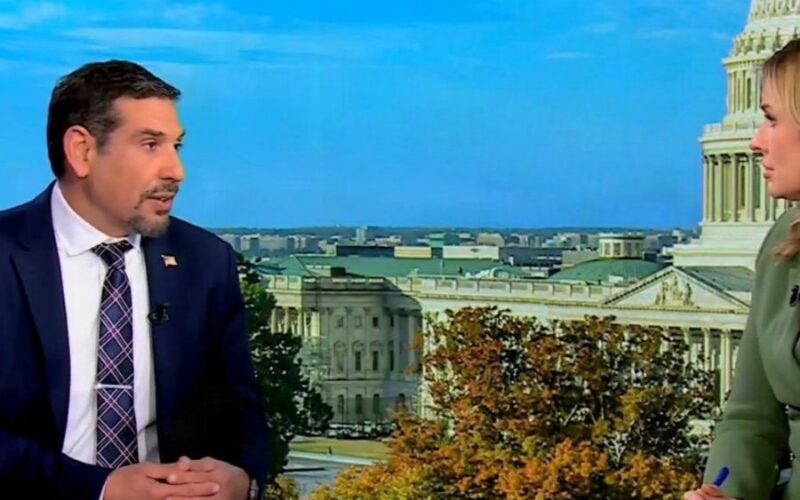
During a contentious interview on CNN, Adam Hamawy, the incoming Democratic Representative from New Jersey, hesitated to identify Iran as an adversary of the United States. Instead, he pointed fingers at both the U.S. and Israel for escalating hostilities with Tehran.
Hamawy, who recently won his congressional seat, was questioned by Pamela Brown regarding his views on foreign policy and military aid to Israel. He emphasized the importance of diplomacy over military actions against Iran.
When pressed on whether he viewed Iran as an American adversary, Hamawy avoided a straightforward response, stating, “We push[ed] them into a fight.” He encouraged a shift in perspective to consider mutual benefits instead of hostilities.
Brown reminded him that Iran’s leaders have historically used anti-American slogans, particularly calling for “death to America,” while militias supported by Iran have killed American troops. In response, Hamawy drew a parallel to U.S. rhetoric, saying, “We’ve been saying death to Iran for decades as well.” He insisted on prioritizing diplomatic solutions.
Insane exchange. Newly elected Democrat Adam Hamawy refuses to call Iran an adversary.
BROWN: Do you see Iran as the adversary?
HAMAWY: “We pushed them into a fight”
BROWN: But are they the adversary?
HAMAWY: “We should be making friends”
BROWN: They’ve been saying “death to America” for decades
HAMAWY: “We’ve been saying ‘death to Iran’”
BROWN: They’ve killed a lot of Americans
HAMAWY: “And we’ve killed a lot of them”
BROWN: So you don’t see Iran as an adversary?
HAMAWY: “I see that we are pushing Iran into a fight”
— RNC Research (@RNCResearch) November 10, 2026
“We’ve killed a lot of them as well,” he added. This exchange underscored a growing divide in American foreign policy as discussions aimed at resolving the Iran conflict are ongoing.
Hamawy further implicated Israel in the escalation of U.S.-Iran relations, without affirmatively declaring Israel as an ally of the United States. He argued that military actions have compromised American safety and had detrimental economic impacts.
He indicated that leveraging diplomatic channels and economic sanctions might be the best approach to deter Iran’s nuclear ambitions. While he recognized Iran’s repressive nature, his reluctance to classify the nation as an adversary attracted significant attention, given its long-standing animosity toward the U.S. and support for hostile groups in the region.
Further scrutiny arose surrounding Hamawy’s background, including his time as a combat surgeon and some controversial affiliations. He previously volunteered at a hospital in Gaza amidst the Israel-Hamas conflict in 2024.
Concerns also surfaced about his historical contacts with the Benevolence International Foundation in the 1990s, a group later linked to al-Qaeda by the 9/11 Commission. Although he was not implicated in any wrongdoing, questions about his past connections to radical figures, like the Blind Sheikh, garnered media attention during his campaign.
Hamawy’s narrative coincides with similar controversial comments from other Democratic figures regarding U.S. interests in the Middle East. He recently took over from retiring Democratic Rep. Bonnie Watson Coleman and will soon become New Jersey’s first Muslim representative in Congress.
This CNN interview may signal the beginning of a broader dialogue on foreign policy perspectives among incoming Democrats as they prepare to assume leadership in the forthcoming session.
Despite Hamawy’s insistence on diplomacy, the persistent questioning from Brown highlighted the core issue—his refusal to categorically label Iran as a threat even in light of its aggressive actions toward the U.S., underscoring a complex and potentially contentious stance on foreign relations.
POLL: Did You Vote Republican In The Midterms?
POLL: Do You Still Stand With Pete Hegseth?
