

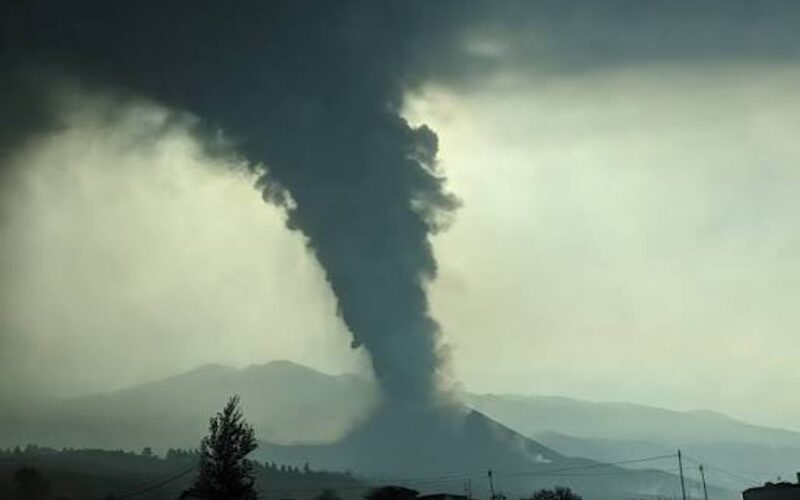
Concerns are rising among researchers regarding a possible landslide from the western flank of the Cumbre Vieja volcano in La Palma, Canary Islands. This mass could potentially plunge into the Atlantic Ocean, triggering a tsunami that might affect the U.S. East Coast.
The situation involves a substantial rock mass, estimated to comprise hundreds of cubic kilometers, which has exhibited signs of disconnect during a 1949 eruption. Studies from the 1990s revealed a gradual outward movement of this mass, measured at about a centimeter or two yearly.
Volcanologist Bill McGuire expressed in a recent article, “Based on extensive studies, I expect this part of the flank will eventually crash into the North Atlantic, launching a megatsunami in the process.” He cautioned, however, that while the event is inevitable, its timing remains uncertain, potentially spanning centuries or even millennia.
'Megatsunami' could reach US East Coast in just hours after catastrophic volcano collapse in Spain, scientist claims https://t.co/JhyW7MmBwg pic.twitter.com/UmooKeKiNo
— Daily Mail US (@Daily_MailUS) November 6, 2026
McGuire highlighted ongoing discussions within the scientific community concerning the severity of the potential tsunami. Computer simulations suggest that a worst-case scenario involving a single massive block could lead to initial water displacement nearly a kilometer tall, with waves up to 65 feet striking Florida roughly nine hours later. Other studies indicate that wave heights along the East Coast could be significantly lower. These travel times are based on the rapid pace of tsunami waves, which can reach speeds comparable to jet aircraft.
Some researchers support their claims with evidence of large boulders found along Bahamian coasts, believed by certain geologists to be remnants from ancient tsunamis originating in the Canary Islands. However, this interpretation remains disputed. Past modeling efforts have shown that rock collapses of 150 to 500 cubic kilometers could produce waves ranging from 10 to 25 meters, though updates to these models have tended to lower these estimates.
According to the U.S. Geological Survey, earlier high-impact scenarios may exaggerate the risks for distant regions. Mapping of the ocean floor suggests that past collapses from the Canary Islands have typically happened in smaller segments rather than as one large event.
Current analyses on slope stability show that the volcano is stable at present, necessitating considerable additional growth for a major collapse to become more plausible. Enhanced tsunami models factoring in energy loss and wave interactions predict maximum heights of about three to seven feet reaching the U.S. East Coast during a significant collapse.
So far, there is no substantial evidence of tsunami sediment deposits on the eastern shores of North or South America to support the occurrence of recurring megatsunamis originating from the Canary Islands.
Meanwhile, the risk near La Palma and its surrounding islands remains considerably higher if a substantial collapse occurs. Such significant collapses are expected over geological timescales of hundreds of thousands of years and will likely be preceded by measurable increases in seismic activity and ground shifts, according to McGuire.
