

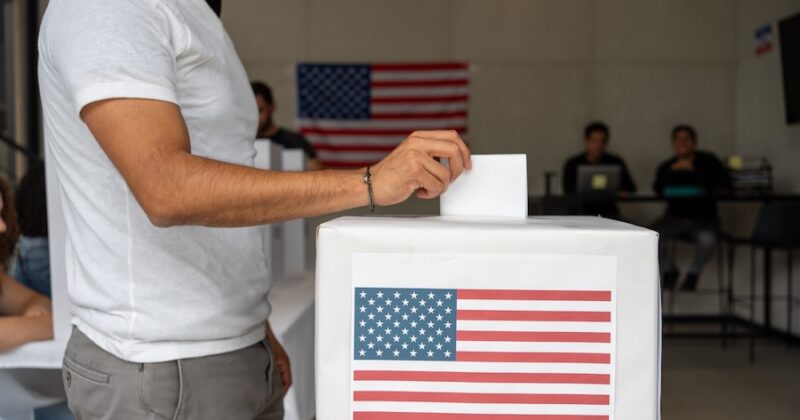
In the 2026 midterm elections, exit polling revealed that a significant number of voters considered the U.S. military actions against Iran to be a crucial issue. This concern combined with increasing household costs appeared to sway many voters’ decisions.
The Voter Poll, conducted by SSRS for various news organizations, indicated that 74 percent of respondents identified the Iran war as a major or crucial factor in their congressional preferences. Notably, 62 percent of these voters leaned towards Democratic candidates, while 35 percent supported Republican ones.
Among the 34 percent who termed the conflict a “crucial” issue, a striking 70 percent favored Democratic candidates, and only 27 percent chose Republicans. Additionally, of the remaining 40 percent who saw it as a major factor, 55 percent supported Democrat candidates compared to 42 percent for Republicans.
In contrast, the 19 percent who deemed it a minor issue favored Republicans 68 percent to 29 percent. Moreover, those who considered it irrelevant backed Republicans 74 percent to 22 percent. These insights are derived from the same SSRS Voter Poll data shared across participating media.
The data also aligns with other surveys on voter attitudes toward the military conflict. An Associated Press Voter Poll revealed that about 60 percent of voters believed the military action against Iran was a mistake. Among Democrats, the opposition hit 95 percent, while 22 percent of Republicans shared that view.
The figure of 62 percent indicating it was a “wrong decision” matched with the 74 percent who found the war to be crucial or significant, as reported by Responsible Statecraft and NBC.
POLL: Does Abdul El-Sayed Belong In The Senate?
Exit polls are showing the GOPs perceived strict immigration enforcement was one of their few winning issues.
The Iran war was a massive losing issue. pic.twitter.com/MVOp3mGqfK
— America First Graphs (@AF_Graphs) November 4, 2026
Pre-election surveys flagged the conflict as a high concern. A Fox News poll conducted in early October found that 75 percent of registered voters were “extremely” or “very” worried about the war. Meanwhile, an AP-NORC survey indicated that 62 percent included it among their top issues, with 31 percent deeming it important but not a priority.
Those against military action exhibited strong support for Democratic congressional candidates, further reflected in the Fox poll data.
Since its onset in late February 2026, the war has been linked to rising energy prices. By election day, average gasoline prices soared to $4.12 per gallon, while diesel reached $6.28 due to disruptions in the Strait of Hormuz, reflecting approximately a 50 percent increase since February.
Approximately 60 percent of voters pointed to President Trump’s policies as the source of these elevated prices. Earlier data from AP-NORC and Gallup showed a larger dissatisfaction with the conflict, where many voters viewed it as not worth the costs.
Younger Trump supporters from the 2024 elections have expressed concerns about the war and the economy, hinting at reduced enthusiasm for participation. Overall, about three-quarters of voters described feelings of anger or dissatisfaction with the country’s direction.
The outcome coincides with historic gains for the Democratic Party in both the House and Senate, significantly impacting Republican candidates in traditionally red states like Iowa, Kansas, South Carolina, and Texas, along with swing states.
