
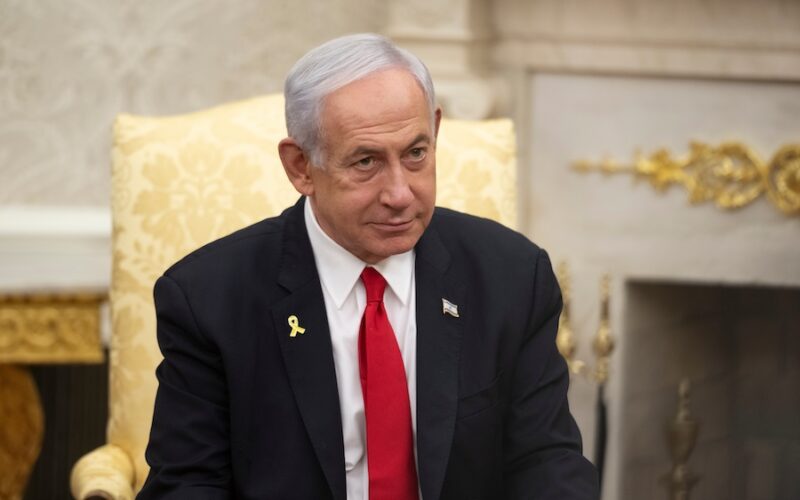
The recent Israeli elections have left Prime Minister Benjamin Netanyahu’s political future hanging in the balance. Exit polls indicate that his governing coalition has not achieved the necessary majority, although his Likud party remains the largest single party.
The initial projections reveal that Netanyahu’s political rivals may have garnered more seats than his coalition, complicating his efforts to remain in power. Neither faction seems capable of reaching the 61 seats needed to lead Israel’s Knesset, suggesting tough coalition talks ahead.
As per the exit polls from Israel’s major news networks, Netanyahu’s right-leaning bloc is expected to secure around 50 seats, while opposition parties may claim between 52 and 53. Additionally, Arab parties are forecasted to achieve approximately 17 or 18 seats, which could grant them significant influence during the formation of a new government.
Despite this, Netanyahu’s Likud party is still projected to hold around 24 to 25 seats, ranking as Israel’s most powerful political entity. The centrist Yashar party, led by former military chief Gadi Eisenkot, is anticipated to capture 21 to 23 seats.
This outcome poses a major obstacle for Netanyahu, who has significantly shaped Israeli politics for nearly two decades and has centered his campaign around national security.
This election marked Israel’s first national vote since the Hamas attacks on October 7, 2023, which ignited ongoing military tensions and intensified challenges regarding Netanyahu’s leadership. Voter turnout was remarkably high, with about 74.3% participation among eligible voters, suggesting an engaged electorate.
A notable surge in participation from Arab communities was observed, with projections indicating historic gains for their political factions, which could be pivotal in deciding the next Prime Minister of Israel. However, many Jewish-led factions have previously been hesitant to collaborate with Arab parties, complicating coalition dynamics.
Eisenkot, campaigning to replace Netanyahu and restore public trust post-October 7, stated that these results reflect a clear “lack of confidence” in the Prime Minister’s leadership. He emphasized the need to act on the voters’ decisions immediately.
Interestingly, not all forecasts were unfavorable for Netanyahu. Supportive Channel 14 predicted his bloc would achieve 60 seats, just shy of the majority mark, contrasting with estimates from other networks.
Following the release of official results, President Isaac Herzog will facilitate discussions on which political leader may form a government. If neither Netanyahu nor Eisenkot can secure enough support, another election may be on the horizon, prolonging Israel’s ongoing political instability.
At present, Netanyahu continues as Prime Minister, but the preliminary results cast a shadow over his political future.
