


After high-level negotiations, Israel and Lebanon have agreed to a ceasefire lasting ten days, as revealed by President Trump on Thursday. This decision may provide a crucial pause in the escalating conflict between the two nations.
The ceasefire is expected to commence at 5 p.m. ET, according to a message from Trump on Truth Social. He highlighted his recent “excellent conversations” with Israeli Prime Minister Benjamin Netanyahu and Lebanese President Joseph Aoun, underscoring the United States’ active role in facilitating this temporary halt.
Trump emphasized that the agreement was designed “to achieve PEACE between their Countries.”
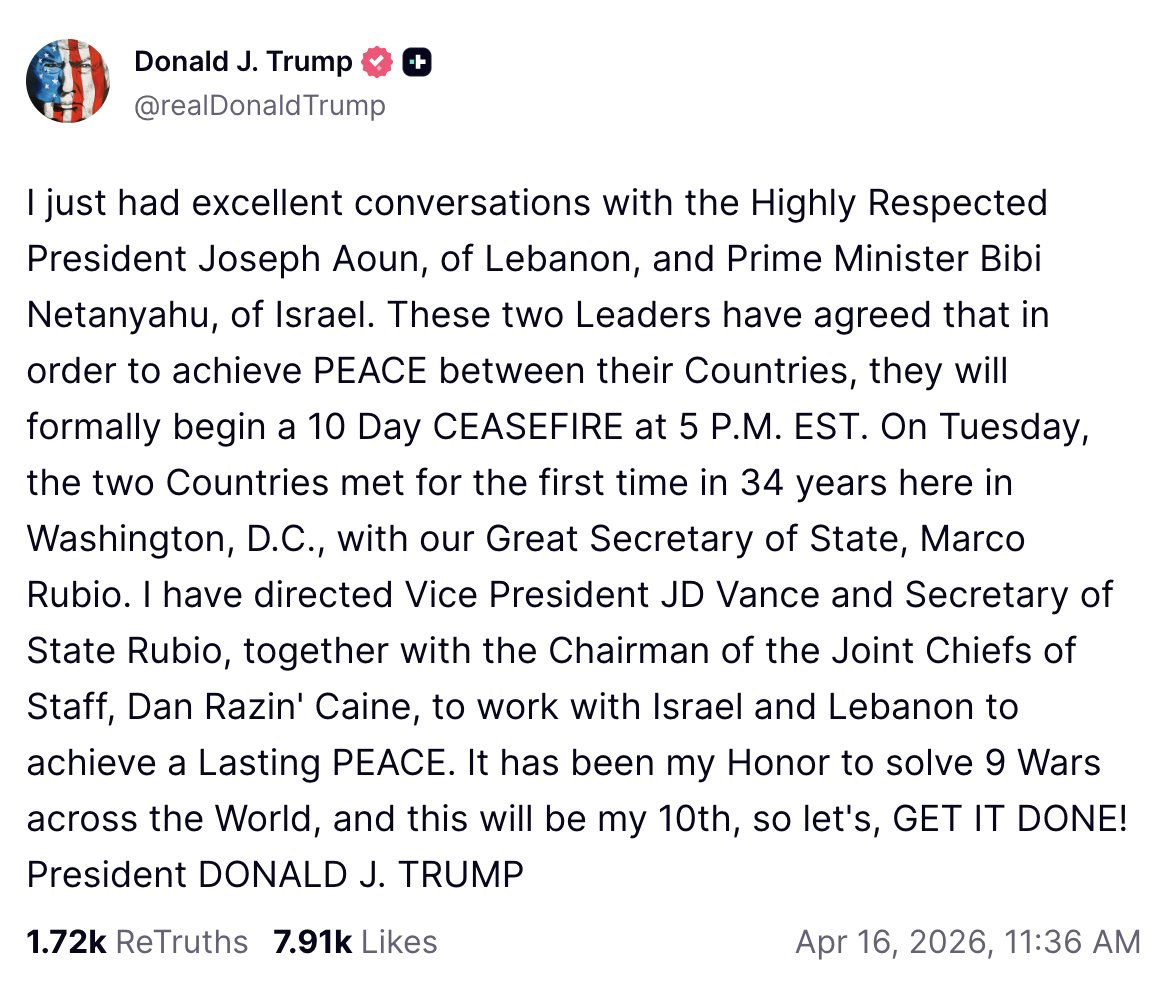
Additionally, the President mentioned that Vice President JD Vance, Secretary of State Marco Rubio, and Joint Chiefs Chairman Dan Caine will collaborate with Israel and Lebanon to pursue a more enduring peace, hinting at the possibility of extending this ceasefire beyond the initial timeframe.
On another front, tensions related to Iran continue to escalate, even as there is some potential for renewed dialogue.
An important development involves the ongoing U.S. naval blockade targeting Iranian ports. American forces have effectively restricted maritime traffic associated with Iran, halting several vessels and advising that any ship attempting to breach the blockade could face military action. Initial reports indicate that this is already influencing key shipping lanes and significantly impacting Iran’s oil exports.
Consequently, Iran is beginning to feel economic pressure. The nation has stopped petrochemical exports in an effort to stabilize its domestic market, a clear indication of economic strain. Analysts warn that this situation cannot persist indefinitely without resulting in significant production cuts.
Moreover, military tensions remain elevated. The U.S. has broadened its enforcement efforts beyond the Persian Gulf, indicating a readiness to act against Iran-linked vessels globally if required. Defense experts have cautioned that further escalation is possible, including potential strikes on critical Iranian energy infrastructure if the current standoff persists.
Despite the mounting pressure, diplomatic efforts are not entirely off the table. While recent U.S.-Iranian talks have stalled, both parties have shown a willingness to continue negotiations.
At this moment, Iran is facing increasing economic and military challenges, with the specter of a broader conflict still a possibility.
