

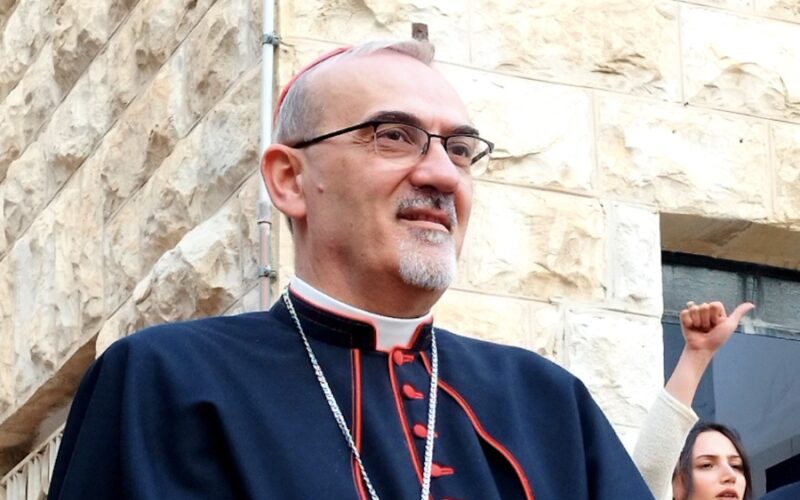
On Sunday morning, the world reacted with outrage as Israeli authorities halted Cardinal Pierbattista Pizzaballa and Fr. Francesco Ielpo from accessing the revered Church of the Holy Sepulchre to preside over Palm Sunday Mass.
This marked a historic moment, as church officials noted it was the first time in centuries that prominent Catholic leaders had been obstructed from celebrating this significant liturgy at such a sacred site.
Since 2020, Cardinal Pizzaballa has held the role of Latin Patriarch of Jerusalem, responsible for guiding the Catholic community across Israel and surrounding regions. This influential position is deeply rooted in history, emphasizing the church’s role in upholding the Status Quo agreement concerning pivotal Christian landmarks.
On Palm Sunday, recognized as the beginning of Holy Week commemorating Jesus’s entry into Jerusalem, the patriarch typically leads Mass at the church. Despite current Israeli restrictions on gatherings due to the ongoing conflict with Iran, the leaders had previously coordinated their visit with local authorities.
They proceeded without public displays, accompanied by a small group of just four individuals, avoiding any overt ceremonial aspects.
However, police intervened en route, instructing the group to turn back. Israeli officials pointed to security directives from the Home Front Command, which have restricted access to major holy sites amid escalating tensions. Authorities further claimed that the patriarch’s earlier request had been assessed and denied due to safety concerns.
Per la prima volta da secoli, ai Capi della Chiesa è stato impedito di celebrare la messa della Domenica delle Palme nella Chiesa del Santo Sepolcro a Gerusalemme. La polizia israeliana ha infatti impedito al Patriarca latino di Gerusalemme, il cardinale Pierbattista Pizzaballa,… pic.twitter.com/SfHqsaI0yz
— Repubblica (@repubblica) March 29, 2026
In response, the Latin Patriarchate and Custody of the Holy Land issued a joint statement condemning the actions as “manifestly unreasonable and grossly disproportionate.” They highlighted that their visit adhered to all existing regulations and involved no public gathering.
Church officials argued that the cardinal’s visit was not intended to attract crowds, a contention that sparked further debate since similar small religious activities at other Jerusalem sites have been permitted.
The incident drew reactions from various governments, with Italian Prime Minister Giorgia Meloni calling the blockade “an offense not only to believers, but to every community that values religious freedom.”
Italy consequently summoned Israel’s ambassador in Rome to register its protests, and strong objections also came from French President Emmanuel Macron and numerous U.S. congressional leaders.
U.S. Ambassador to Israel Mike Huckabee publicly acknowledged the broader safety issues affecting all holy sites, including the Western Wall. However, he remarked that the specific decision regarding this small group was “an unfortunate overreach” that lacked clear justification.
Huckabee further noted that Israel had expressed intentions to collaborate with the patriarch for the safe observance of Holy Week. Moreover, both church and Israeli officials have indicated ongoing discussions to resolve these access challenges for the rest of the week.
Israeli Prime Minister Benjamin Netanyahu directly addressed the situation, declaring there was “no malicious intent whatsoever, only concern for his (Pizzaballa’s) safety and that of his party.” He assured that measures were in place to facilitate worship access in the upcoming days.
