

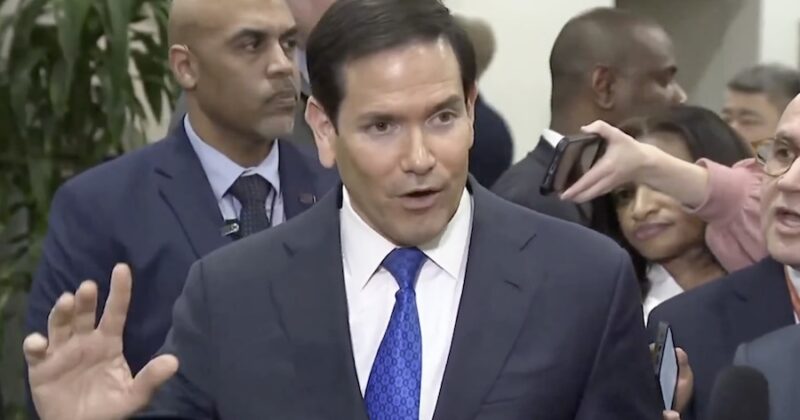
Secretary of State Marco Rubio delivered a blunt defense of the Trump administration’s military campaign against Iran and abruptly ended an exchange with reporters.
Rubio’s Defense
He was addressing the escalating U.S.-Israel operation targeting Iranian missile infrastructure when reporters raised criticism from some voices on the political right.
Before the reporter could expand, Rubio launched into a forceful explanation of the administration’s decision.
He said the United States had made a decision and that the president had exercised his authority to act.
Rubio argued the strikes were needed to stop Iran from expanding missile and drone capabilities that threaten American forces and global security.
“Iran cannot have these missiles, cannot have these drones, cannot threaten the world,” Rubio said.
“The president said this is the weakest they’ve ever been,” he added.
“If we don’t hit them now, a year from now, a year and a half from now, no one will be able to touch them,” Rubio said.
WATCH:
According to Rubio, the president judged a preemptive strike offered the best chance of preventing a much larger conflict later.
He said coordinating the operation with Israel increased the likelihood of success.
The secretary warned that allowing Iran to attack first could have greatly increased the danger to American troops across the region.
“We were not going to absorb a blow from them,” Rubio said.
“We were going to go first,” he added.
Rubio suggested that waiting for Iran to act could have cost American lives and weakened the campaign’s ability to eliminate key targets.
“He was not going to run the risk that they could attack us before we could hit them,” Rubio said.
“Because in addition to costing lives, it would undermine the effectiveness of our operations,” he added.
As reporters tried to press on, Rubio abruptly ended the conversation.
The comments arrive as President Donald Trump manages one of the most consequential foreign-policy crises of his presidency.
U.S. forces have carried out a sweeping series of strikes across Iran in coordination with Israeli forces in an operation that targeted missile launchers, air-defense systems, and military command infrastructure.
The operation began after U.S. intelligence concluded Iran had positioned weapons capable of striking American bases across the Middle East and raised fears a large-scale confrontation was imminent.
