

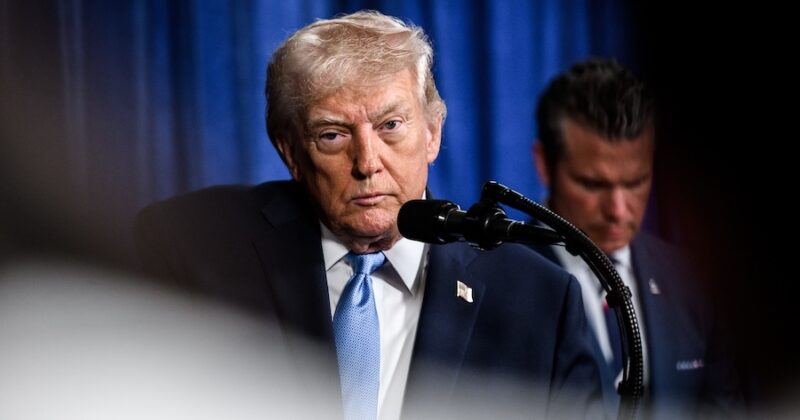
The Supreme Court on Friday struck down most of President Trump’s sweeping tariffs, dealing a sharp blow to a centerpiece of his second-term economic agenda and ruling that his reliance on an emergency powers law was unlawful.
The decision wipes out what the Trump administration had described as the president’s most consequential economic and foreign policy initiative, rejecting his attempt to use the International Emergency Economic Powers Act to reshape global trade.
The justices flatly dismissed the administration’s argument that the decades-old statute gave Trump authority to impose tariffs on nearly every country.
“We claim no special competence in matters of economics or foreign affairs,” Chief Justice John Roberts wrote for the court.
“We claim only, as we must, the limited role assigned to us by Article III of the Constitution. Fulfilling that role, we hold that IEEPA does not authorize the President to impose tariffs.”
Trump is the first president in the law’s nearly 50-year history to invoke IEEPA for tariffs. The statute, enacted in the 1970s, allows presidents to “regulate” imports in response to national emergencies posing an “unusual and extraordinary” threat. The court ruled that power does not extend to broad-based tariffs.
The ruling lands despite Trump’s string of recent Supreme Court victories and underscores the court’s skepticism toward the administration’s expansive view of executive authority. The justices questioned whether the emergencies cited by Trump justified such a far-reaching economic program.
Beginning in February, Trump declared a national emergency tied to fentanyl trafficking, using it to justify tariffs on Canada, China and Mexico. He later invoked a trade deficit emergency to roll out so-called reciprocal tariffs on dozens of trading partners.
Lower courts had allowed the levies to remain in place while the legal fight played out. Those measures are now largely invalidated.
RELATED: SCOTUS Decision On Mail-In Voting Rules Could Shape Future Elections
Tariffs issued under separate legal authorities — including sector-specific duties on steel, aluminum and copper — were not part of the case and remain in effect.
Trump had repeatedly warned that a ruling against him could trigger severe economic consequences, calling the case one of the most important in U.S. history. Behind the scenes, the administration argued the tariffs were essential to national security and economic stability.
The fallout is expected to be immediate. Companies that paid billions under the now-invalidated tariffs are likely to press for refunds.
Even before the decision, major firms, including Costco, parts of the Toyota Group, Revlon, and hundreds of others, had filed lawsuits to preserve their claims. Legal experts say the ruling could unleash a wave of repayment demands and fresh litigation over how and when the government must return the money.
