

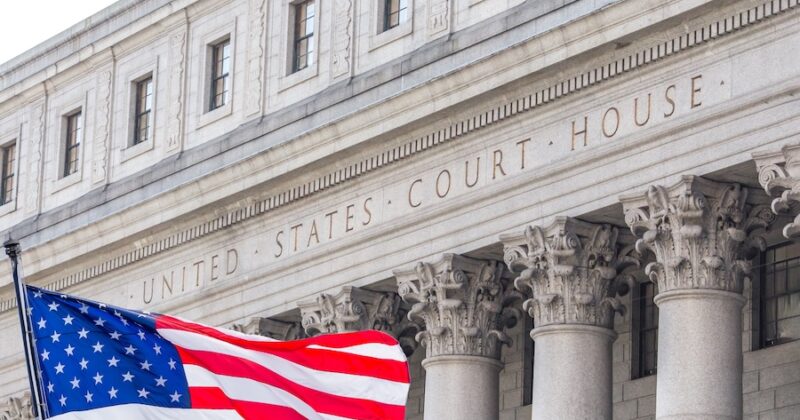
The U.S. Supreme Court ruled 7-2 last week that Rep. Michael Bost, an Illinois Republican, has legal standing to challenge an Illinois election law that allows mail-in ballots postmarked by Election Day to be received and counted for up to two weeks afterward, a decision that could shape how voting rules are litigated in future elections.
The case does not decide whether Illinois’ receipt deadline is lawful. Instead, the court revived Bost’s lawsuit and sent it back to lower courts to consider the merits.
Illinois law requires election officials to count mail-in ballots postmarked or certified no later than Election Day and received within two weeks of Election Day. Bost and two other candidates sued in 2022, arguing that counting ballots after Election Day conflicts with federal statutes that set a uniform day for federal elections.
Lower courts dismissed the lawsuit on standing grounds, concluding the plaintiffs had not shown a sufficiently direct injury. The Seventh Circuit, for example, pointed to Bost’s past electoral performance and treated alleged campaign costs tied to monitoring late-arriving ballots as voluntary steps taken to avoid a hypothetical harm.
Chief Justice John Roberts, writing for the majority, rejected that approach and held that candidates have a personal stake in vote-counting rules in their own elections. The opinion said an unlawful election rule can harm a candidate in multiple ways, but went further by recognizing an additional interest in “a fair process,” even apart from whether a rule changes the outcome.
In the court’s view, candidates are uniquely affected when the rules for counting votes depart from what the law requires, because the integrity of the process is tied to the legitimacy of whoever wins. The opinion also pointed to the practical consequences of forcing disputes to the last minute, warning that waiting until just before Election Day, or after ballots are counted, risks voter confusion and instability if courts step in too late.
Justice Amy Coney Barrett concurred in the judgment, joined by Justice Elena Kagan, but argued the case should be resolved using a more traditional standing theory. Barrett said Bost had standing because he alleged “pocketbook” harm from added campaign expenses tied to monitoring late-arriving ballots, rather than standing based simply on his status as a candidate.
Justice Ketanji Brown Jackson dissented, joined by Justice Sonia Sotomayor, arguing the majority’s approach weakens the court’s usual requirement that plaintiffs show a concrete, particularized injury. In her view, an interest in election fairness is broadly shared, and the court’s ruling could invite more candidate-filed lawsuits over election administration rules.
The immediate impact may be procedural but significant: by lowering the barrier to getting into federal court, the ruling could increase pre-election challenges to rules governing vote counting and ballot deadlines, including disputes over how long ballots can arrive after Election Day and still be counted. The decision could also steer litigation earlier in the calendar, rather than after close races, because candidates can sue without proving a substantial risk of losing.
For Illinois, the next step now returns to the lower courts, where judges will have to decide whether the state’s two-week receipt window is compatible with federal election-day statutes for federal contests.
Whatever the outcome, the Supreme Court’s standing ruling is likely to be cited in future fights over mail voting rules, especially as states continue to rely on absentee and vote-by-mail systems that can take days to fully process.
