

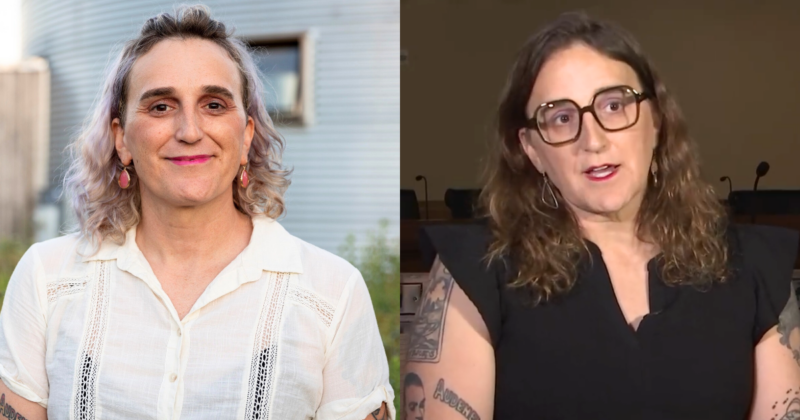
“Trans” Minnesota State Rep. Leigh Finke, a Democrat, is facing mounting scrutiny after publicly encouraging continued anti-ICE demonstrations at churches following a disruptive protest that unfolded during a Sunday worship service in St. Paul.
The incident occurred at Cities Church, where activists entered the sanctuary during services and interrupted worship with chants and shouting.
Parishioners reported that the disruption created fear and confusion, particularly among families with young children present.
Video from the scene shows protesters confronting congregants while one individual livestreamed the confrontation online.
Public backlash intensified after Finke responded on social media by defending the protest and calling for similar actions to continue.
In his statements, Finke argued that churches connected to Immigration and Customs Enforcement (ICE) leadership should remain targets of what he described as nonviolent direct action.
He maintained that sustained pressure is necessary until ICE is removed from Minnesota and the current administration leaves the White House.
The protest quickly drew the attention of federal authorities.
The Department of Justice (DOJ) confirmed it is reviewing the incident for potential violations of the federal Freedom of Access to Clinic Entrances (FACE) Act.
While the law is often associated with abortion-related cases, it also applies to places of religious worship.
The statute prohibits obstruction, intimidation or interference with individuals exercising their right to worship and carries criminal penalties, The Gateway Pundit reported.
DOJ official Alina Habba addressed the matter publicly, emphasizing that the FACE Act is a longstanding federal law designed to protect religious freedom.
She noted that any conduct involving threats, obstruction, or interference at houses of worship is taken seriously and may result in prosecution if violations are found.
According to multiple reports, the demonstration was led in part by Black Lives Matter activist Nikema Armstrong.
The protest focused on the church’s pastor, who also serves as a regional ICE official.
During the disruption, activist William Kelly recorded himself confronting attendees, accusing congregants of hypocrisy and making inflammatory remarks.
In a subsequent post, Kelly stated that he felt “good” about his actions at what he described as a “white supremacist church” after later visiting a nearby Somali mosque.
Finke, who was named one of USA Today’s “Women of the Year” in 2023, acknowledged the controversy surrounding his remarks but stood by his position.
According to The Post Millennial, he framed the church protest as part of a broader tradition of civil disobedience, citing past demonstrations by ACT UP and WHAM at St. Patrick’s Cathedral in New York during the AIDS crisis.
He also invoked the legacy of Martin Luther King Jr., arguing that nonviolent resistance is intentionally disruptive and necessary to force societal change.
In follow-up comments, Finke wrote that nonviolent protest is “by design, uncomfortable, disquieting, and upsetting” and said such tactics are meant to create moral urgency.
He argued that criticism of the church protest reflects resistance from those invested in maintaining the status quo.
Members of the Cities Church congregation, however, described the experience in starkly different terms.
Several parishioners said the protest crossed a line by targeting families during a religious service, warning that such actions risk normalizing political intimidation inside sacred spaces.
Community members expressed concern about the long-term implications of allowing ideological disputes to spill into places of worship.
The DOJ has not released further details about the scope or timeline of its investigation, but officials reiterated that protections for religious practice are a core federal priority.
As the inquiry continues, the incident has sparked a broader debate across Minnesota over the boundaries between protest rights and the legal protections afforded to religious institutions.
Legal analysts note that the case could test how federal authorities balance First Amendment demonstrations with statutes designed to ensure worship can occur without harassment or obstruction.
The outcome may have implications well beyond Minnesota as similar protests emerge nationwide.

Never trust a “Trans”…they on drugs for the rest of their lives. If he can persuade you to referring him as a she, you are already at his mentality level and all i can say, may God have mercy on you all correcting Him!
That is one fugly “woman”.