

Shortly before 3:30 a.m. EST Tuesday, the National Oceanic and Atmospheric Administration’s Space Weather Prediction Center reported that severe G4 geomagnetic storm levels had once again been reached.
But despite an extremely powerful coronal mass ejection and geomagnetic storm, the Northern Lights did not explode across the sky the way many expected.
The culprit was the solar wind’s magnetic field, which pointed north, the same direction as Earth’s magnetic field. When that happens, the two repel each other, sending charged particles off course instead of funneling them into the atmosphere to ignite a vivid aurora, according to the FOX Forecast Center.
Even so, more than 25 states had a shot at seeing the Northern Lights as the powerful CME barreled through space on a collision course with Earth.
Fox Weather said it received photos from viewers in Alabama, Kentucky, Pennsylvania, Connecticut, Virginia, Minnesota and other states. The aurora was even spotted overseas in Wiesbaden, Germany.
The space weather event traces back to an X1.9-class solar flare that erupted from the sun around 11:09 a.m. Sunday.
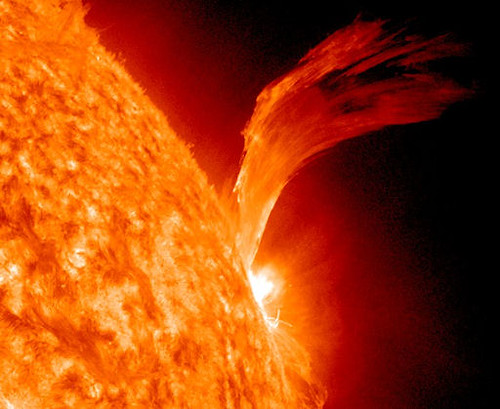
C3-class Solar Flare Erupts on Sept. 8, 2010
Because that energy travels at the speed of light, it reached Earth in just eight minutes, ionizing the upper atmosphere and triggering a level R3, or strong, radio blackout over western South America and the eastern South Pacific.
The flare was accompanied by a CME, a massive expulsion of plasma and magnetic fields from the sun’s corona. Unlike the flare’s light, a CME is a physical bubble of solar material that moves more slowly through space, acting like a shock wave as it pushes through the solar system.
“Agencies around the world have modeled this specific eruption and reached a consensus that the western flank of the CME will impact Earth’s magnetic field this evening,” the FOX Forecast Center said.
Parts of the Northeast, Midwest, Mid-Atlantic and sections of the West caught glimpses of the light show Monday night.
The best viewing chances were in the Pacific Northwest, the eastern Dakotas and Minnesota, though the Northern Lights were photographed as far south as New Mexico and Alabama.
The Space Weather Prediction Center uses a five-point scale to rank geomagnetic storms, solar radiation storms and radio blackouts, ranging from minor to extreme.
The FOX Forecast Center said the current event marks the largest solar radiation storm in 23 years.
A geomagnetic storm is a major disturbance of Earth’s magnetosphere caused by an unusually efficient transfer of energy from the solar wind into the space surrounding the planet, according to SWPC.
The latest activity follows another rare solar super-flare in November that sent radiation levels in Earth’s atmosphere to their highest point in nearly two decades.
That flare, an exceptionally bright burst of light, erupted from the AR4274 sunspot on Nov. 11. Classified as a powerful X5.1, it came after a string of milder flares and CMEs that delivered aurora displays as far south as Florida.
When Earth-based monitors detected elevated radiation levels that day, researchers launched several stratospheric balloons equipped with sensors to track how radiation changed throughout the atmosphere.
At cruising altitudes for most commercial aircraft, about 40,000 feet, radiation levels briefly spiked to 10 times higher than normal cosmic-ray background levels. Researchers noted that if a pregnant woman were exposed to those conditions for more than 12 hours, the radiation would exceed what is officially considered safe for a fetus.
